

Trade Agreements
Trade Agreements EU and United States
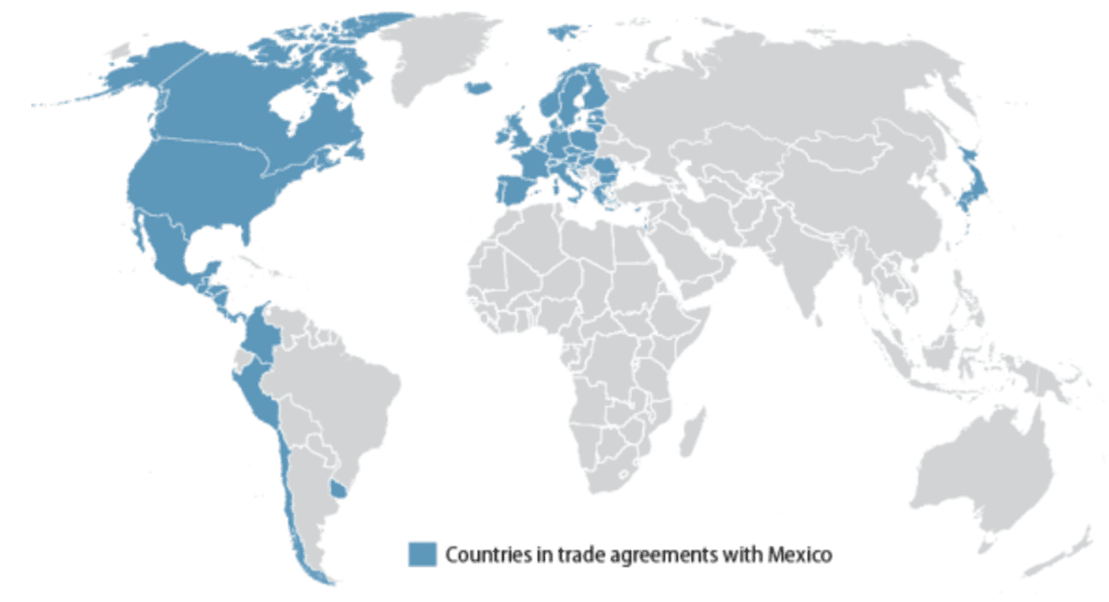
Mexico is a member of the World Trade Organization (WTO) and has 13 free trade agreements (FTAs) that cover 50 countries, including the Comprehensive and Progressive Agreement for Trans-Pacific Partnership (CPTPP). It was the first country in Latin America to sign a partnership agreement with the European Union. In addition, the USMCA Agreement (previous Nafta) encourages US companies to set up manufacturing facilities in Mexico. This allows free trade between the three major economies in North America.
Accordingly, manufacturing companies are significantly increasing in investment into Mexico which makes them of one of the most competitive and open market in the world.
Some Hard Facts
- Over 50 trade agreements
- No other country than Mexico has more trade agreements
- USMCA Agreement is key for nearshoring
- Asian companies take advantage of USMCA agreement
- International Standards must be followed with the USMCA agreement
Trade Agreements European Union
No other countries than Mexico has signed more free trade agreements and it was the first country in Latin America to sign a partnership agreement with the European Union (1997). At least 47 in North, Latin America, Europe and Asia allows free flow of goods and services and is therefore very attractive to start your production, your service or distribution center. They have removed several non-tariff barriers and reduced import duties on exports.
In 2020, the European Union was Mexico’s third largest source if imports, just after the United States and China. This includes machinery, appliances, transport equipment, chemical products, computer and information services. In the same year, the European Union was Mexico's second-biggest export market after the US. The EU's key imports from Mexico are machinery and appliances, transport equipment, optical/photographic instruments, and mineral products. As a foreign direct investment, the EU is the second largest investor in Mexico after the US.
What are the positive effects of NAFTA?
The United States, Mexico and Canada build together theUSMCA agreement(which replaced NAFTA), making North America one of the world’s largest free trade zones. The USMCA agreement ensure an import-export of goods and services without difficulties. This strong trade ties with both the United States and Canada helps to mitigate some of the risks associated with doing business in the Mexico (security & corruption). In 2022, Mexico was the second-largest trading partner with 455 billion USD exports, just behind China with 537 billion USD.
Mexico is the first or second-largest export destination for more than 25 US states. Top US product exports include electronics, machinery, plastics, fuels, minerals and vehicles. In addition, Mexico is the second-largest agricultural export market for the US and imported US$19.5 billion worth US agricultural products in 2018.
During Trump’s legislation, the three countries announced that they had come to terms on a newtrade agreementthat preserved much of NAFTA but introduced a number of significant changes, which was branded theUnited States–Mexico–Canada Agreement(USMCA).Some of the most significant terms of the new agreement related to automobile manufacture.
- Under NAFTA, the corresponding requirement had been only 62.5 percent.
- Under the USMCA, in order for a car or truck to be exempt from tariffs, 75 percent of its components would have to be manufactured inNorth America.
- The agreement also required that at least 30 percent of work on tariff-exempt vehicles must have been done by workers earning at least $16 per hour (significantly more than Mexican employees receive)
How has NAFTA benefited Mexico?
NAFTA plays an essential role in transforming Mexico's economy and positioning it as an important player in North America's economic and political landscape. Indeed, this agreement is the key of the success why Mexico has experienced a Nearshoring boom over the last three years as well as it will keep a significant role for the future.
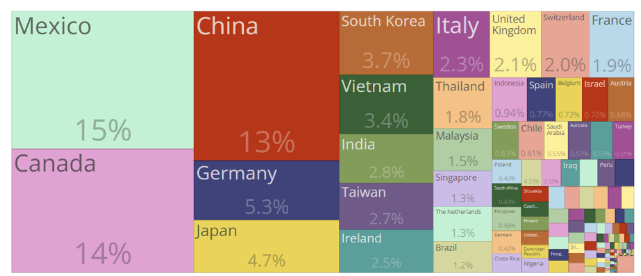
As we can see in the graph, in the last five years, there has been a remarkable shift in U.S. imports, with both Mexico and Canada surpassing China as the leading sources. China's share of U.S. imports declined to 13.35%, while Mexico accounted for 16% and Canada for 15%. This change was primarily influenced by the imposition of tariffs by the Trump Administration on Chinese imports and the COVID-19 pandemic, which revealed the dangers of relying heavily on a single source for raw materials and finished products.
Asians take advantage of the USMCA agreement
Due to the shipping chaos and geopolitical fractures caused by the pandemic and the supply chain crisis, many Asian companies do not want to lose one of the main market United States. In addition, when Trump became president and forced to put tariffs on hundreds of billions of dollars in Chinese imports, they realized that they cannot be dependent on their own manufacturing but also need to diverse their portfolio.
Thus Asian companies establishing factories that allow them to label their goods such as electronic, apparel, clothing or furniture “Made in Mexico,” then trucking their products into the United States duty-free. Indeed, more than 400 North American companies have the intention to carry out a relocation process from Asia to Mexico – and over 400 Asian companies announced the do the same.
USMCA enforces Labor Rights
The transformation of labor conditions in Mexico will be a crucial aspect due to the requirements of the United States-Mexico-Canada Agreement (USMCA), which mandates the enforcement of domestic labor laws along with adherence to international standards. Mexico took significant steps towards achieving these changes by enacting labor reforms on May 1, 2019, which granted workers enhanced rights and increased the power of labor unions to organize. While these reforms hold the potential for long-term success in Mexico's labor movements, successful implementation will be pivotal.
Mexican companies will need to make adjustments to their internal structures to comply with the new labor provisions and establish effective relationships with labor unions. These changes are expected to empower Mexican labor unions with greater negotiating power; however, they may also lead to increased friction and labor disputes as the dynamics between employers and unions evolve.
Despite the changes and uncertainty of NAFTA being re-negotiated as the new United States-Mexico-Canada Agreement, the major manufacturing industries in Mexico are expected to see continual growth. Respective governments have streamlined certain regulations which allow businesses to establish operations in Mexico with little difficulty.
USMCA provides Predictability
To sum up, thanks to the USMCA agreement, Mexico has a stronger investment framework and more transparency, clarity and protections for businesses operating in the country. The agreement’s biggest shift will take place at the macroeconomic level, as the USMCA solidifies trade rules and provides greater certainty for North American businesses operating across the continent. The agreement not only provides planning certainty and stability for Asian and American companies, but also for European countries which want to enter new markets and produce in Central America.
What are the Pros and Cons of the Nafta Agreement
While NAFTA brought numerous benefits to Mexico, it also had some disadvantages and negative consequences for the country. After reaching a deal on the final version of the new United States-Mexico-Canada Agreement (USMCA), President Donald Trump tweeted that it “will be the best and most important trade deal ever made by the USA”.
Indeed, the two deals – NAFTA and USMCA – have some significant differences which are in favor of the United States.
- The new agreement USMCA requires 75% of a vehicle’s parts to be made in one of the three countries – up from the current 62.5% rule – in order to remain free from tariffs when moving between the three signatory countries.
- NAFTA has been criticized for moving manufacturing jobs to Mexico due to lower wages, prompting Democrats to push for labor rule enforcement in the USMCA to protect American workers. The USMCA negotiations resulted in modifications to enforcement language, gaining support from the AFL-CIO, the largest federation of unions in the US.
- Under the original NAFTA, agricultural products traded among the three countries had tariffs eliminated. As part of the USMCA, these zero tariffs will be maintained, and there will be additional access for US dairy, poultry, and eggs in the Canadian market, while the United States will allow more Canadian dairy, peanuts, peanut products, and a limited amount of sugar to be imported.
There are various other Cons of the USMCA agreement such as what happens if the United States should cancel the agreement or what negative environmental impacts has the increased industrial activity in some regions, leading to pollution and deforestation, raising concerns about sustainable development.


