Data Centers in Mexico: The Quiet Technological Shift Reshaping Nearshoring
Executive Introduction: A Different Kind of Nearshoring
Nearshoring in Mexico is often associated with automotive plants, electronics assembly, or labor-intensive manufacturing. Yet beneath the surface, a quieter transformation is underway. Digital infrastructure—particularly data centers and advanced IT manufacturing—is becoming a material driver of Mexico’s integration into North American supply chains.
This shift matters because data centers are not standalone assets. They depend on industrial land, power availability, logistics access, and regulatory clarity—the same fundamentals that shape industrial real estate decisions. As nearshoring matures, Mexico’s competitiveness increasingly rests on its ability to host both physical production and digital infrastructure.
Export Data Signals a Structural Change
Based on the Harmonized System (HS) trade classification, computer and data-processing equipment accounted for 25.9% of total U.S. imports from Mexico during the first five months of the year, according to U.S. trade data. This is a notable signal: technology-related exports are no longer peripheral to Mexico’s manufacturing base.
Industry associations reinforce this trend. The Mexican Association of Information Technology Industry reported that up to 30% of manufacturing investment in Mexico is now linked to information technologies, including semiconductor-related production.
This suggests that nearshoring is evolving beyond assembly toward digitally intensive value chains.
From Manufacturing to Digital Infrastructure
According to Gabriela Siller, Director of Economic Analysis at Banco Base, these figures point to a new phase for Mexico’s industrial ecosystem—one that extends well beyond fintech startups or isolated tech hubs.
In practice, this evolution has been visible for several years:
- Hyperscale and colocation data center developments such as ODATA
- Industrial software and automation expansions by Schneider Electric and Siemens
- Growth in automation, logistics software, cybersecurity, and data analytics firms
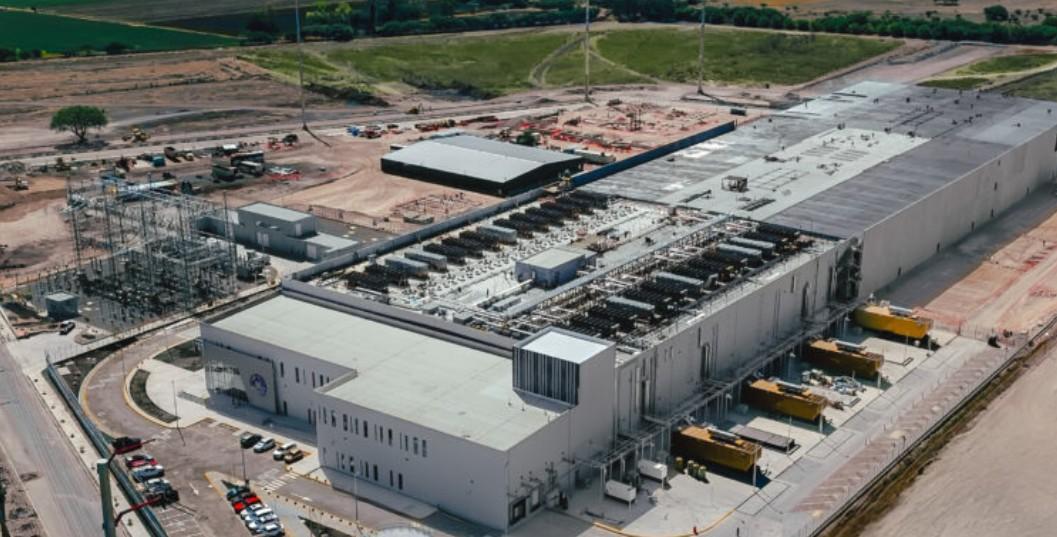
What differentiates this wave is scale. Data centers require large industrial plots, redundant power supply, fiber connectivity, and long-term operational stability, tying them directly to industrial park development and site selection strategies.
Why Mexico Is Gaining Share from Asia
The International Monetary Fund has documented that Mexico has captured a meaningful portion of the U.S. electronics and semiconductor market share previously held by China between 2017 and 2023.
In its working paper “Relocation of Global Value Chains: The Role of Mexico,” the IMF notes that:
Mexican exports of electronic products and semiconductors gained significant U.S. market share as Chinese imports declined.
This shift is not solely about tariffs. It reflects:
- Shorter supply chains
- Reduced geopolitical exposure
- Faster delivery times to U.S. markets
- Compatibility with USMCA rules of origin
For digital infrastructure operators, proximity matters not only for latency but also for regulatory alignment and operational predictability.
Data Centers: Energy, Land, and Location Sensitivity
Unlike traditional manufacturing, data centers are energy-intensive but labor-light. Their site selection logic prioritizes:
- Reliable power capacity and grid stability
- Competitive electricity pricing
- Cooling conditions
- Redundant connectivity
- Security and regulatory certainty
According to André Rizzo, Director for Industry, Science, and Technology at Turner & Townsend Mexico, domestic demand for data processing and artificial intelligence is expanding rapidly.
“Mexico can serve U.S. demand, but it does not depend on it. Local demand alone is strong enough to sustain growth,” Rizzo explains.
This distinction is critical. It means that data center investment in Mexico is not merely an export play, but part of a domestic digital transformation.
Investment Outlook: Measurable and Capital-Intensive
The Mexican Data Center Association estimates that the sector will attract approximately USD 9.2 billion in direct investment over the next five years. By 2029, data centers are projected to contribute around 5.2% of Mexico’s GDP.
These are not speculative figures. They reflect committed capital pipelines tied to:
- Cloud computing
- Artificial intelligence
- E-commerce logistics
- Financial services
- Industrial automation
Each of these use cases reinforces demand for industrial real estate with advanced infrastructure specifications.
Regional Concentration: Where Digital Meets Industrial
Data center investment is clustering in regions that already function as industrial anchors:
- Querétaro – power availability, connectivity, and central location
- Nuevo León – industrial scale, cross-border logistics, skilled technical labor
- Jalisco – technology ecosystem and electronics manufacturing base
- Sonora – energy projects and U.S. proximity
These regions illustrate how industrial parks are evolving: no longer designed solely for assembly lines, but for hybrid manufacturing-digital operations.
Implications for Industrial Real Estate and Site Selection
For companies evaluating expansion in Mexico, the rise of data centers changes the conversation:
- Industrial parks must accommodate higher power density
- Land planning must consider long-term energy access
- Permitting timelines become a critical risk factor
- Proximity to substations and fiber corridors gains importance
This reinforces why site selection decisions increasingly integrate digital infrastructure requirements, even for firms outside the tech sector.
Decision Takeaway
Mexico’s data center expansion is not a side story—it is a structural shift in how nearshoring is unfolding. As digital and physical supply chains converge, industrial real estate, energy infrastructure, and technology investment become inseparable.
For investors and operators, the key question is no longer whether Mexico can host advanced digital infrastructure, but where and under what conditions it can scale sustainably.
FAQ – Typical Search Questions
Why are data centers expanding in Mexico?Due to nearshoring, U.S. market proximity, rising domestic demand, and Mexico’s growing share in electronics exports.
How big is the data center investment pipeline in Mexico?Industry estimates point to around USD 9.2 billion over five years.
Which regions attract the most data center projects?Querétaro, Nuevo León, Jalisco, and Sonora.
How do data centers affect industrial real estate demand?They increase demand for large industrial plots with high power capacity and infrastructure redundancy.
Is this trend dependent on the U.S. market?No. Domestic demand for cloud computing and AI is sufficient to sustain growth.