Hiring Costs in Mexico: Salaries, Talent and Strategy

Executive Summary
Labor costs in Mexico remain globally competitive, but companies must understand the underlying dynamics when hiring.
Key takeaways:
- Average monthly salary in Mexico: ~$540 USD
- Manufacturing salaries slightly above average (~$566 USD)
- Skilled and technical roles range between $698–$886 USD
- Leadership roles exceed $1,100 USD
- Rising wages and competition are reshaping hiring in Mexico
The key insight:Mexico is still cost-efficient—but strategic hiring and location decisions determine real cost advantage.
Introduction
For companies evaluating manufacturing in Mexico, labor cost is a key driver—but often misunderstood.
The reality:
- Mexico is no longer just a low-cost location
- It is a value-driven manufacturing hub
- Salaries reflect increasing skill levels and industrial maturity
Understanding salary structures is essential for:
- Budget planning
- Site selection
- Workforce strategy
Labor Costs in Mexico: Sector-Level Overview
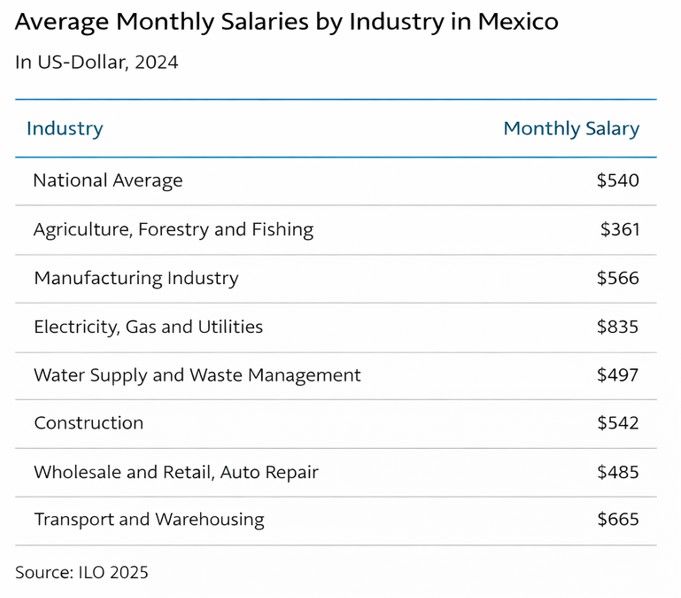
The following data provides a breakdown of average monthly salaries by industry (USD, 2024):
Key insights:
- Manufacturing (processing industry): ~$566 USD/month
- Transport & logistics: ~$665 USD
- Information & communication: ~$780 USD
- Finance sector: ~$900 USD
- National average: ~$540 USD
What this means:
- Manufacturing in Mexico remains cost-efficient compared to higher-value sectors
- Industrial labor is competitively priced relative to productivity
- Higher wages in advanced sectors indicate increasing specialization
Salary Structure by Position
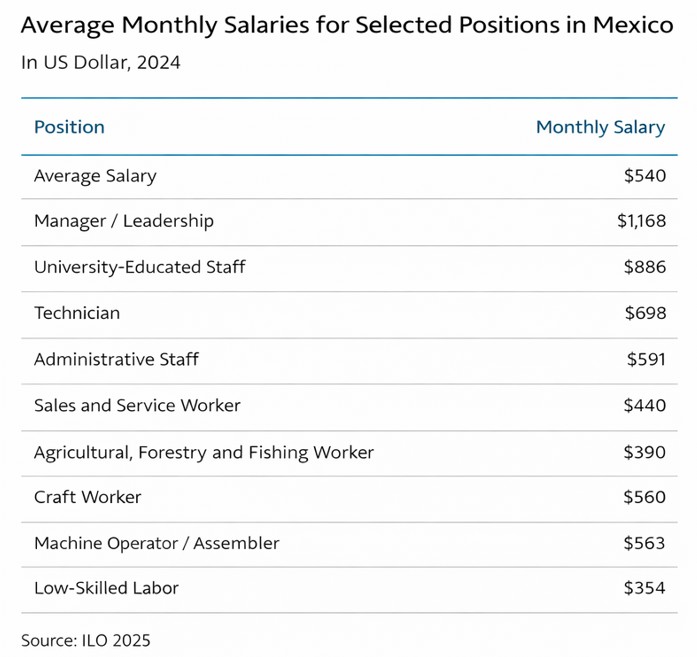
Salary differences become clearer when analyzed by role:
Key benchmarks:
- Leadership roles: ~$1,168 USD/month
- University-educated staff: ~$886 USD
- Technicians: ~$698 USD
- Machine operators: ~$563 USD
- Administrative staff: ~$591 USD
- Low-skilled labor: ~$354 USD
Interpretation:
- Mexico offers a full labor cost spectrum, from low-cost operators to skilled engineers
- Technical talent remains affordable compared to the U.S. or Europe
- Wage differences allow flexible workforce structuring
Hiring in Mexico: Cost vs Availability
While labor costs are attractive, availability is the real constraint.
Key dynamics:
- Industrial hubs face strong competition for talent
- Skilled roles (engineers, technicians) are harder to fill
- Wage increases are driven by demand—not regulation alone
This creates a critical reality:
Low wages do not automatically mean easy hiring.
Why Labor Costs Are Increasing
Several structural factors are driving wage increases:
- Minimum wage adjustments
- Increased labor benefits (vacation, bonuses)
- Upcoming transition to a 40-hour workweek
- Strong demand due to nearshoring Mexico
Despite this:
Mexico remains significantly more competitive than:
- United States
- Western Europe
Strategic Insight: Cost Advantage Depends on Location
Labor cost varies significantly by region.
In high-demand regions:
- Salaries are higher
- Competition is stronger
- Hiring timelines increase
In secondary regions:
- Lower wages
- Limited talent pool
- Higher retention risk
Conclusion:
Site selection Mexico directly impacts hiring costs and workforce stability.
Cost vs Productivity: The Real Advantage of Mexico
The key advantage is not just low cost—but cost-to-productivity ratio.
Mexico offers:
- Competitive wages
- Strong manufacturing experience
- High workforce adaptability
This makes manufacturing in Mexico particularly attractive for:
- Labor-intensive production
- Complex assembly
- High-mix, mid-volume operations
What This Means for Companies Expanding to Mexico
Companies should adjust their hiring strategy based on:
1. Role segmentation
- Separate low-skill and high-skill hiring strategies
- Plan different compensation structures
2. Location strategy
- Evaluate labor cost vs availability
- Avoid purely cost-driven decisions
3. Long-term workforce planning
- Include training and retention
- Anticipate wage increases
Conclusion
Labor costs in Mexico remain highly competitive—but are evolving.
Key takeaways:
- Salaries are rising, especially in industrial hubs
- Skilled labor is still cost-efficient globally
- Hiring strategy must go beyond salary benchmarking
For companies entering nearshoring Mexico, success depends on:
- Understanding salary structures
- Aligning hiring with location
- Building long-term workforce strategies
FAQ
What is the average salary in Mexico?Around $540 USD per month across all sectors.
How much do manufacturing workers earn in Mexico?Approximately $566 USD per month on average.
Are labor costs in Mexico increasing?Yes, due to regulation and demand from nearshoring.
Is Mexico still a low-cost manufacturing location?Yes, especially compared to the U.S. and Europe.
What roles are most expensive in Mexico?Leadership and highly skilled technical roles.
Why Mexecution
Understanding labor costs in Mexico is only one part of the equation.
The real challenge is aligning:
- Salary levels
- Talent availability
- Industrial location
Mexecution supports companies with:
- Data-driven site selection Mexico based on labor cost and availability
- Identification of regions with optimal workforce conditions
- Transparent insights into industrial ecosystems
- Independent advisory without commission-driven bias
The right location reduces not just costs—but long-term operational risk.