Baja California Sur, Hidalgo, and Nayarit Lead Mexico’s Industrial Growth in 2025

Why New Industrial Growth Regions in Mexico Matter for Investors
Mexico’s industrial landscape is entering a new phase. While traditional manufacturing powerhouses such as Coahuila, Chihuahua, and Baja California remain critical pillars of the country’s export economy, recent data from 2025 shows that new regional winners are emerging across the Mexican industrial market.
According to INEGI data, Baja California Sur, Hidalgo, and Nayarit recorded the strongest industrial growth rates in Mexico during 2025, despite a nationwide industrial contraction of 1.3%. This shift reveals an important trend for international manufacturers, industrial developers, and foreign investors: industrial growth in Mexico is becoming more diversified, infrastructure-driven, and regionally specialized.
For companies evaluating manufacturing in Mexico, industrial real estate opportunities, or supply chain expansion strategies, understanding these emerging industrial regions is increasingly important.
Mexico’s Industrial Activity in 2025: A Market in Transition
Mexico’s industrial economy slowed during 2025 due to several macroeconomic pressures:
- Reduced momentum from federal megaprojects
- Weakness in the oil and energy sector
- Slower engineering and infrastructure activity
- Global supply chain uncertainty
- U.S. tariff discussions affecting manufacturing investment decisions
However, despite the broader slowdown, several states significantly outperformed the national average.
Figure 1 – Mexico Industrial Activity by State in 2025
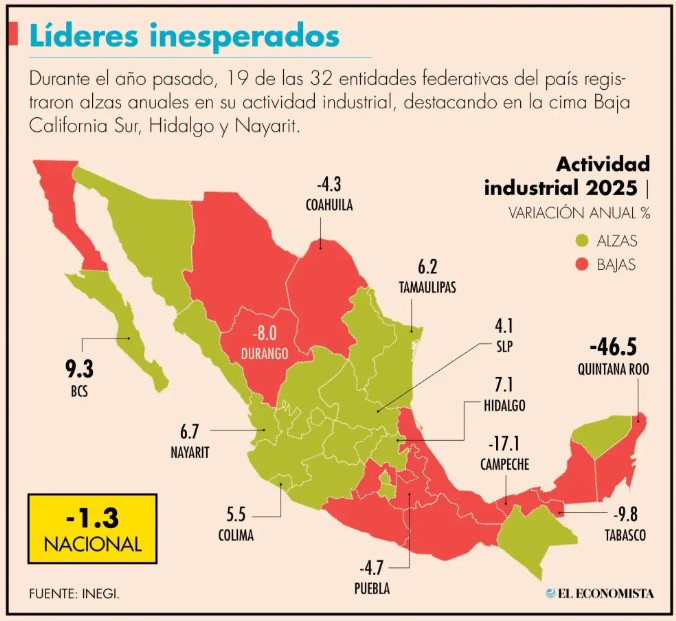
Map of Mexico showing industrial growth and contraction by state.
The map demonstrates how industrial growth is increasingly concentrated in states with:
- logistics advantages,
- infrastructure investments,
- manufacturing connectivity,
- export-oriented supply chains,
- and nearshoring potential.
This is particularly relevant for companies pursuing supply chain diversification in North America.
Baja California Sur: Infrastructure and Energy Expansion Drive Growth
Baja California Sur recorded the highest industrial growth in Mexico during 2025 with an annual increase of 9.3%.
Unlike traditional manufacturing-heavy states, the region’s growth was largely driven by:
- tourism infrastructure,
- real estate construction,
- energy generation projects,
- and logistics modernization.
Los Cabos and La Paz have experienced substantial infrastructure investment, including:
- hospitality developments,
- energy systems,
- airport improvements,
- and urban expansion.
For industrial investors, Baja California Sur represents a different type of industrial opportunity. Rather than large-scale automotive manufacturing, the state offers:
- construction supply chains,
- energy infrastructure projects,
- specialized logistics,
- cold chain operations,
- and consumer goods distribution.
Although the market remains smaller than Monterrey, Saltillo, or Querétaro, it highlights how industrial demand in Mexico is broadening beyond traditional export manufacturing.
Hidalgo: Nearshoring and Automotive Manufacturing Expansion
Hidalgo ranked second nationally with industrial growth of 7.1%.
The state is increasingly attracting attention from foreign manufacturers due to:
- proximity to Mexico City,
- central logistics positioning,
- lower operating costs,
- industrial land availability,
- and strong highway connectivity.
Hidalgo’s growth has been strongly linked to:
- automotive manufacturing,
- industrial relocation,
- warehousing,
- and nearshoring investments.
For foreign investors, Hidalgo offers an interesting alternative to more saturated industrial hubs.
Why Hidalgo Is Gaining Attention
Several factors are improving Hidalgo’s competitiveness within the Mexico industrial real estate market:
1. Lower Occupancy Costs
Compared to Monterrey or northern border cities, industrial lease rates and labor costs remain more competitive.
2. Central Supply Chain Access
Manufacturers can efficiently serve:
- Mexico City,
- Puebla,
- Querétaro,
- Guanajuato,
- and the Bajío region.
3. Growing Automotive Ecosystem
The state benefits from proximity to major automotive clusters and Tier 1 suppliers.
4. Industrial Land Availability
Unlike heavily constrained markets, Hidalgo still offers expansion potential for:
- build-to-suit projects,
- logistics parks,
- and manufacturing campuses.
This positions Hidalgo as a strong candidate for companies seeking scalable industrial operations in Mexico.
Nayarit: An Emerging Industrial and Infrastructure Story
Nayarit recorded industrial growth of 6.7% during 2025.
Historically, the state has not been considered a primary industrial hub. However, this is gradually changing due to:
- infrastructure upgrades,
- logistics improvements,
- tourism-related development,
- and Pacific trade corridor opportunities.
The expansion of western Mexican logistics corridors is creating indirect industrial demand for:
- warehousing,
- construction materials,
- distribution facilities,
- and transportation services.
For international firms, Nayarit is not yet a primary manufacturing destination comparable to Nuevo León or Chihuahua. However, it may become increasingly relevant for:
- regional distribution,
- Pacific supply chain operations,
- and infrastructure-linked investment strategies.
Tamaulipas Continues Benefiting from U.S. Proximity
Tamaulipas also remained among Mexico’s strongest industrial performers in 2025 with growth of 6.2%.
The state continues benefiting from:
- cross-border manufacturing,
- energy operations,
- logistics infrastructure,
- and export manufacturing integration.
Its proximity to the United States remains one of its biggest advantages.
For manufacturers focused on:
- automotive,
- electronics,
- industrial equipment,
- and cross-border supply chains,
Tamaulipas continues to offer strong strategic value.
Why Some Traditional Industrial States Slowed Down
Interestingly, several major manufacturing states recorded industrial contractions during 2025:
- Coahuila: -4.3%
- Chihuahua: -2.1%
- Baja California: -1.0%
This does not necessarily indicate structural weakness. Instead, it reflects:
- slower investment decisions,
- tariff uncertainty,
- export caution,
- and temporary manufacturing slowdowns.
U.S. Tariffs and Investment Uncertainty
Many international companies delayed:
- capital expenditures,
- supplier expansion,
- and manufacturing relocations
while waiting for greater clarity regarding U.S. trade policy.
However, the slowdown has not eliminated Mexico’s long-term manufacturing advantages.
In fact, many companies continue evaluating Mexico because:
- USMCA protection remains highly valuable,
- labor availability remains competitive,
- and supply chain regionalization continues accelerating.
The End of the Megaproject Cycle Is Affecting Southern Mexico
The strongest industrial contractions occurred in:
- Quintana Roo (-46.5%)
- Campeche (-17.1%)
- Tabasco (-9.8%)
These declines are largely tied to:
- the completion of large infrastructure projects,
- weaker oil sector activity,
- and reduced federal construction spending.
States highly dependent on:
- oil production,
- government megaprojects,
- or energy infrastructure
experienced sharper slowdowns once these projects matured.
This highlights an important lesson for investors:
Sustainable Industrial Growth Depends on Manufacturing Ecosystems
Long-term industrial success in Mexico is increasingly linked to:
- manufacturing density,
- supplier networks,
- export connectivity,
- logistics infrastructure,
- and workforce specialization.
States deeply integrated into North American supply chains tend to show stronger resilience.
Industrial Corridors Are Becoming More Important Than Individual States
One of the most important trends emerging from 2025 is the growing importance of industrial corridors.
Rather than evaluating states individually, investors increasingly analyze:
- logistics corridors,
- supplier ecosystems,
- border connectivity,
- highway access,
- rail infrastructure,
- and labor availability.
The strongest industrial growth tends to occur in regions connected to:
- U.S. exports,
- automotive manufacturing,
- advanced manufacturing,
- and logistics infrastructure.
This explains why:
- Hidalgo,
- Tamaulipas,
- Jalisco,
- and parts of western Mexico
continue attracting industrial activity.
What Foreign Investors Should Consider
For international manufacturers entering Mexico, the 2025 industrial data reinforces several key lessons.
1. Mexico Is No Longer a Single-Market Story
Industrial opportunities now extend beyond:
- Monterrey,
- Tijuana,
- and Ciudad Juárez.
Secondary markets are becoming increasingly attractive.
2. Infrastructure Matters More Than Ever
States investing in:
- ports,
- highways,
- energy,
- and logistics
are becoming more competitive.
3. Supply Chain Connectivity Is Critical
The best industrial locations are not always the cheapest. They are the ones most connected to:
- suppliers,
- customers,
- and export routes.
4. Nearshoring Continues Driving Regional Differentiation
The nearshoring boom is not evenly distributed across Mexico. Companies should carefully evaluate:
- labor markets,
- infrastructure,
- incentives,
- and industrial ecosystem maturity.
Conclusion: Mexico’s Industrial Map Is Evolving
Mexico’s industrial market in 2025 reveals a country in transition.
While traditional industrial hubs remain essential to North American manufacturing, emerging states such as Hidalgo, Nayarit, and Baja California Sur are gaining momentum through:
- infrastructure investment,
- logistics expansion,
- and nearshoring-related demand.
At the same time, the slowdown in certain border and oil-dependent states demonstrates that industrial growth in Mexico is becoming increasingly selective and ecosystem-driven.
For foreign manufacturers and investors, this creates both opportunities and challenges.
Choosing the right location now requires a deeper understanding of:
- industrial supply chains,
- infrastructure readiness,
- labor dynamics,
- and long-term regional competitiveness.
Companies that properly evaluate Mexico’s evolving industrial corridors will be better positioned to build resilient and scalable operations in North America.
FAQ – Mexico Industrial Growth and Investment Trends
Which Mexican states had the highest industrial growth in 2025?
Baja California Sur, Hidalgo, and Nayarit recorded the strongest industrial growth rates in Mexico during 2025 according to INEGI data.
Why is Hidalgo attracting manufacturing investment?
Hidalgo benefits from:
- central location,
- lower costs,
- automotive supply chain access,
- and strong logistics connectivity to central Mexico.
Is nearshoring still driving investment in Mexico?
Yes. Despite temporary uncertainty related to tariffs and global trade policy, nearshoring remains one of the main drivers of industrial investment in Mexico.
Why did some industrial states decline in 2025?
States such as Coahuila and Chihuahua experienced temporary slowdowns due to:
- cautious investment behavior,
- export uncertainty,
- and delayed manufacturing decisions linked to U.S. tariffs.
Which regions in Mexico are best for industrial investment?
The best regions depend on:
- industry type,
- supply chain needs,
- labor availability,
- and logistics requirements.
Key industrial corridors continue to include:
- Monterrey,
- Bajío,
- Tamaulipas,
- Querétaro,
- and increasingly Hidalgo.