Long-Term USMCA Agreement Seen as Key to Boosting Investment in Mexico
Executive Introduction: Certainty Over Short-Term Noise
Global trade uncertainty, announced tariffs and an ongoing review of the United States–Mexico–Canada Agreement (USMCA) have created a challenging backdrop for foreign direct investment (FDI) decisions in Mexico. Economists and analysts widely agree that the investment climate will hinge on trade certainty more than short-term tariff announcements.
For Mexico, the structural question is not just whether it remains competitive, but whether companies can be confident that preferential access to the U.S. market will endure. Recent discussions among economic analysts highlight that investment decisions today are driven by predictability over speculation.
Mexico’s Export Ties: A Trade Relationship of Scale
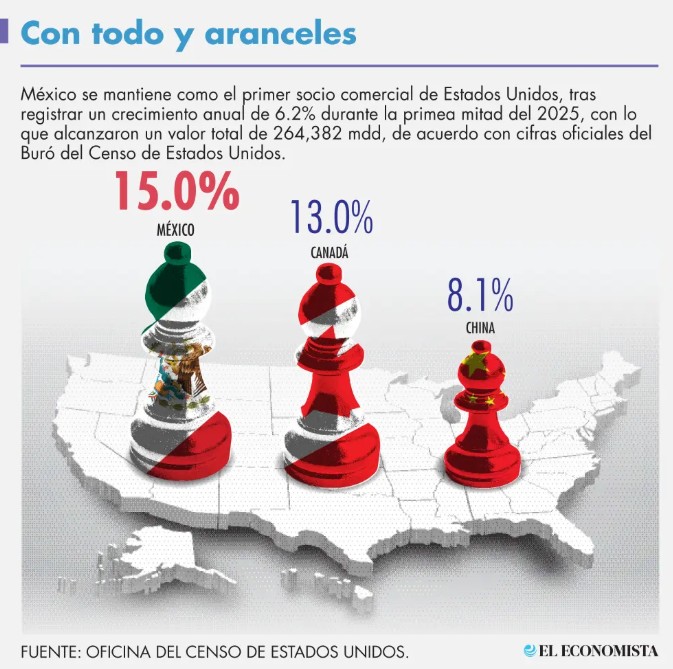
Despite the global backdrop, Mexico continues to play a dominant role in U.S. trade. According to U.S. Census Bureau data, Mexico accounts for roughly 15% of total U.S. imports, exceeding both Canada (13%) and China (8.1%) in market share—a clear indicator of Mexico’s integration into North American supply chains.
This graphic shows how Mexico’s share of U.S. imports remains the largest among key trading partners, even in an environment of tariff volatility.
Tariffs Have Raised Stakes – and Ambiguity
Economists at Bx+, Kapital and Actinver emphasized during a panel discussion that the uncertainty tied to tariffs and USMCA renegotiation schedules has slowed investment activation. The economist chief at Bx+, Alejandro Saldaña, noted that USMCA’s protection helped Mexican exports grow sooner than expected, becoming “a lifeline for the Mexican economy.” Yet he also pointed out that this export stability has not yet translated into higher fixed investment because “there is no certainty that USMCA rules will last over time.”
A long-term USMCA framework would provide the policy stability needed for capital commitments that often span decades, not policy cycles.
What Investors Are Watching
Analysts argue that the USMCA review planned for mid-2026 will likely include:
- Stricter rules of origin
- Greater North American content requirements
- Potential implicit pressure on Mexico to adopt protective tariff postures
These factors influence multinationals’ decisions to commit to new facilities and technology investments. Executives continue to “see how all the pieces are being arranged on the board” before green-lighting significant expansions, as noted by analysts from Kapital.
Investment Climate and Strategic Position
Despite uncertainty, Mexico’s relative position remains favorable compared with other emerging markets. Its deep integration with the U.S. supply chain and preferential trade regime provide a context where investment attractiveness is not binary—but conditional.
Several trends support this view:
- Trade data shows Mexico’s export momentum remains resilient even amid tariff adjustments (2025 cumulative exports and trade surplus figures indicate continuity in export performance).
- Forecasts suggest exports could grow around 6% in 2025 and 6.5% in 2026, partly driven by supply-chain reconfiguration under nearshoring logic.
- Foreign direct investment totaled a record high—around USD 41 billion by Q3 2025, a roughly 15% increase compared to 2024, signaling continued investor interest despite trade volatility.
These figures suggest that investor confidence is resilient when macro-framework clarity exists.
Why Long-Term Agreements Matter More Than Tariff Cuts
Short-term tariff relief or temporary pauses can ease immediate pressures, but long-term investment decisions require institutional and legal certainty. For capital-intensive projects like manufacturing facilities, data centers, and semiconductor plants, a multi-year horizon under stable rules is critical.
Economic analysts highlight that expecting firms to commit billions without a clear sense of future tariff exposure or rules of origin is unrealistic. Investors effectively price in policy risk, and uncertainty raises the required hurdle rate for new projects.
Policy Implications for Mexico’s Competitiveness
A stable USMCA framework can support:
- Foreign direct investment (FDI) pipelines
- Technology transfer and high-value manufacturing
- Long-term planning horizons for supply chain integration
In practice, certainty in USMCA can act as a lever for Mexican policymakers to encourage investment flows and attract relocations from Asia or other regions.
Trade and investment specialists argue that Mexico is positioned “better than others” in the current tariff environment, but can only fully realize that advantage if trade rules are durable and predictable.
Turning Uncertainty Into Strategy
Global and local risks remain, but Mexico’s integration with North America offers a competitive edge. Investment decisions will continue to be shaped by:
- USMCA negotiations and rule-of-origin certainty
- Tariff expectations and trade stability
- Sector-specific demand for resiliency in supply chains
Economists suggest that once the long-term agreement framework is clarified, companies could return to investing with greater confidence.
Decision Takeaway
Mexico’s attractiveness is maintained not just by geography or cost, but by the promise of stable, durable trade access through USMCA. Investors today are waiting for clarity on this commitment, which will be pivotal to unlocking new rounds of foreign direct investment.
In a global context of policy volatility, certainty is the new competitive advantage.
FAQ
How important is the USMCA for investment in Mexico?Very important; long-term rule certainty under USMCA is seen as critical to encouraging fixed investment.
Is Mexico still a major trading partner of the U.S.?Yes; Mexico represents around 15% of U.S. imports, the largest share among U.S. partners.
Have tariffs reduced Mexico’s attractiveness?Tariffs have created volatility, but Mexico’s relative tariff position remains competitive compared to other countries and doesn’t erase its market role.
What do investors need most now?Long-term policy clarity and durable trade rules.
Will investment return once USMCA is clarified?Analysts suggest confidence will likely improve and investment decisions will follow.