Mexico Records Historic FDI in 2025 Despite Slower U.S. Investment
Executive Summary
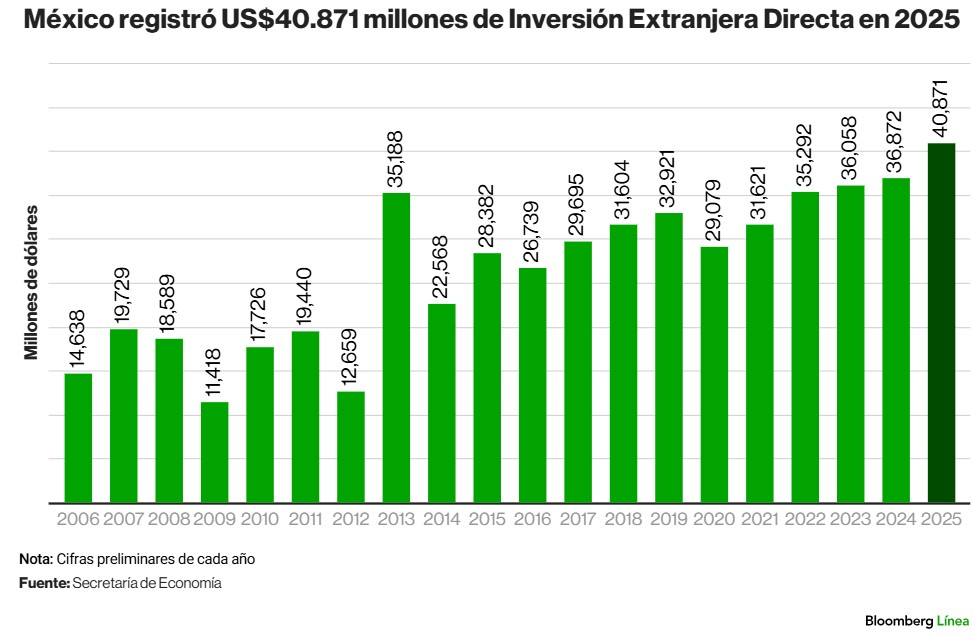
Mexico recorded a historic USD 40.87 billion in foreign direct investment (FDI) in 2025, representing a 10.8% increase compared to 2024. The data confirms that manufacturing in Mexico continues to attract international capital, despite tariff uncertainty and slower investment flows from the United States.
 A key development is the strong recovery in new investment projects, which increased by 132.9% year-over-year, indicating that companies are not only expanding operations but also launching new manufacturing facilities in Mexico.
While the United States remains the largest investor, capital flows from Spain, Canada, and Europe increased significantly, reflecting a broader diversification of investors. These trends reinforce Mexico’s role as one of the most important nearshoring destinations for global manufacturing companies.
Mexico’s Foreign Direct Investment Reaches a Record Level
Foreign direct investment in Mexico reached USD 40.87 billion in 2025, marking the highest annual level ever recorded by the Mexican Secretariat of Economy.
This represents a 10.8% increase compared to 2024, continuing a five-year upward trend in foreign direct investment in Mexico.
For companies considering manufacturing in Mexico, the data confirms a crucial point: global investors continue to increase long-term commitments despite geopolitical uncertainty, tariff debates, and slower growth in certain capital flows.
Long-Term Investment Growth in Mexico
The long-term trend of foreign direct investment in Mexico highlights a structural transformation of the country’s industrial economy.
Between 2006 and 2025, investment inflows gradually increased as Mexico strengthened its role in North American manufacturing supply chains.
Key drivers include:
- Nearshoring of global manufacturing operations
- Integration of supply chains under the USMCA trade agreement
- Competitive labor costs
- Expansion of industrial infrastructure
For companies planning manufacturing expansion in Mexico, the steady rise in investment demonstrates sustained global confidence in the country’s industrial platform.
New Investments Surge in 2025
One of the most important developments in the 2025 data is the recovery of new investments.
Foreign direct investment in Mexico consists of three main components:
Reinvestment of earnings
- USD 27.65 billion
- 67.7% of total FDI
New investments
- USD 7.38 billion
- +132.9% growth compared to 2024
Intercompany accounts
- USD 5.84 billion
- +17% year-over-year
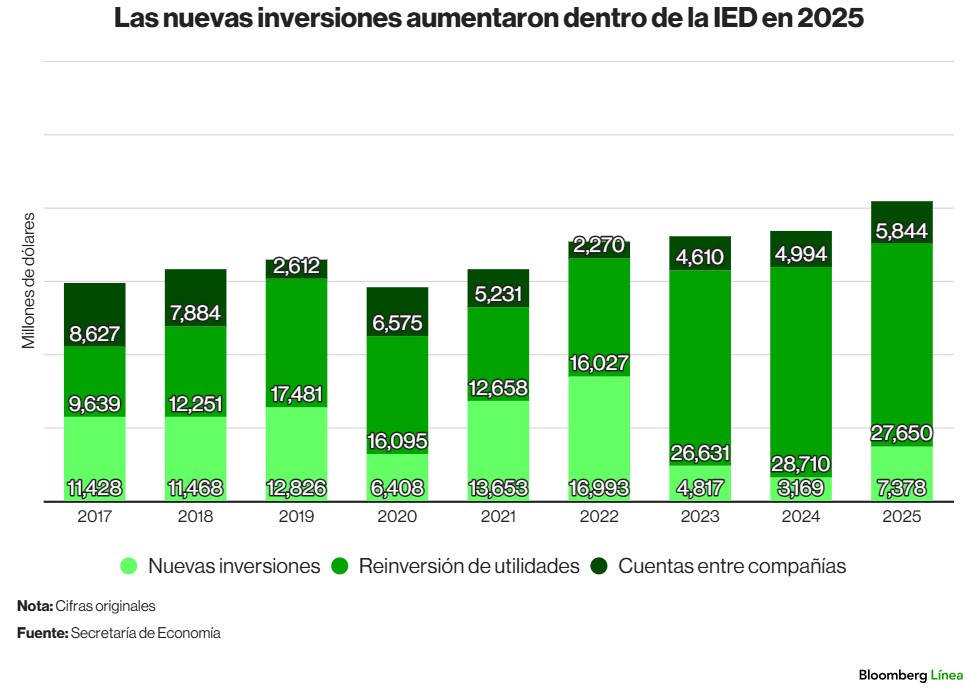
The strong increase in new investments in Mexico suggests that multinational companies are launching new production projects rather than only expanding existing operations.
For firms evaluating manufacturing in Mexico, this is one of the most important signals in the 2025 data.
U.S. Investment Slows but Europe Gains Momentum
Although the United States remains the largest investor in Mexico, capital flows slowed slightly in 2025.
FDI by country of origin:
- United States: USD 15.88 billion (-3.8%)
- Spain: USD 4.43 billion (+290%)
- Canada: USD 3.32 billion
- Netherlands: USD 2.39 billion
- Japan: USD 2.29 billion
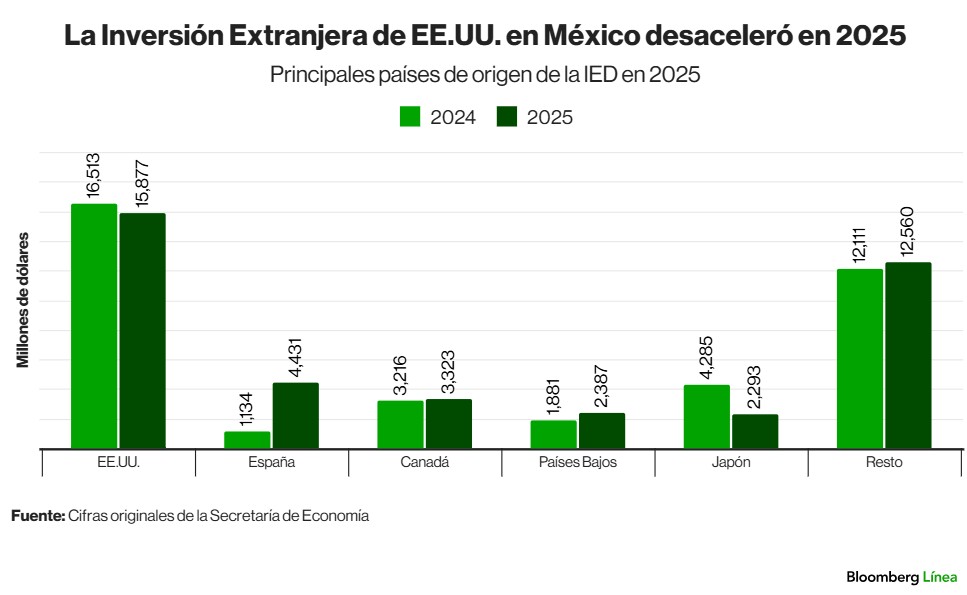
Together, these five countries account for 69% of all foreign direct investment in Mexico.
The surge in Spanish investment partly compensated for slower U.S. flows, highlighting a diversification of international investors entering the Mexican market.
Regional Investment Clusters in Mexico
Foreign investment remains highly concentrated in a few regions.
The top destinations for foreign direct investment in 2025 were:
- Mexico City: USD 22.38 billion
- Nuevo León: USD 3.63 billion
- State of Mexico: USD 3.28 billion
Together, the top five states captured more than 80% of total FDI.
For manufacturing companies, however, industrial investment is often concentrated in:
- Northern Mexico
- Nuevo León
- Bajío industrial corridor
- Central Mexico manufacturing clusters
These regions offer strong advantages for manufacturing in Mexico, including logistics access, industrial parks, and proximity to the U.S. market.
What the 2025 FDI Data Means for Manufacturing in Mexico
The record level of foreign direct investment confirms several long-term structural trends.
First, nearshoring continues to reshape global manufacturing as companies move production closer to the United States.
Second, the rebound in new investment projects indicates that companies are launching new factories and production lines in Mexico.
Third, the diversification of investment sources suggests that Mexico is attracting global capital beyond North America, including Europe and Asia.
For companies evaluating manufacturing expansion in Mexico, these trends indicate that the country remains one of the most competitive industrial locations in the Western Hemisphere.
FAQ – Foreign Direct Investment and Manufacturing in Mexico
Why did foreign direct investment in Mexico reach a record in 2025?
Foreign direct investment in Mexico increased due to nearshoring, strong manufacturing exports, and new capital projects launched by multinational companies.
Which countries invest the most in Mexico?
The largest investors in Mexico are the United States, Spain, Canada, the Netherlands, and Japan, which together account for about 69% of total FDI inflows.
Why is manufacturing in Mexico attracting more investment?
Manufacturing in Mexico benefits from proximity to the U.S. market, competitive production costs, and strong integration under the USMCA trade agreement.
What role does nearshoring play in Mexico’s investment growth?
Nearshoring has encouraged companies to relocate production closer to North American markets, significantly increasing investment in Mexico’s manufacturing sector.