Mexico Remains Attractive for Investment Despite Global Uncertainty
Executive Introduction: From Boom to Structural Continuity
The global investment environment has entered a phase of sustained uncertainty. Trade tensions, tariff announcements, and the ongoing review of the United States–Mexico–Canada Agreement (USMCA) have slowed decision-making across North America. Yet slowdown does not equal retreat.
Mexico is no longer experiencing the nearshoring “boom” seen in 2023. Instead, it is entering a more selective, structurally driven phase of investment, where capital continues to flow—but with clearer priorities, tighter risk filters, and sector-specific focus.
Recent investment data and policy signals suggest that Mexico remains attractive, not because uncertainty has disappeared, but because companies are adapting their strategies rather than abandoning them.
Investment Announcements: Lower Volume, Continued Momentum
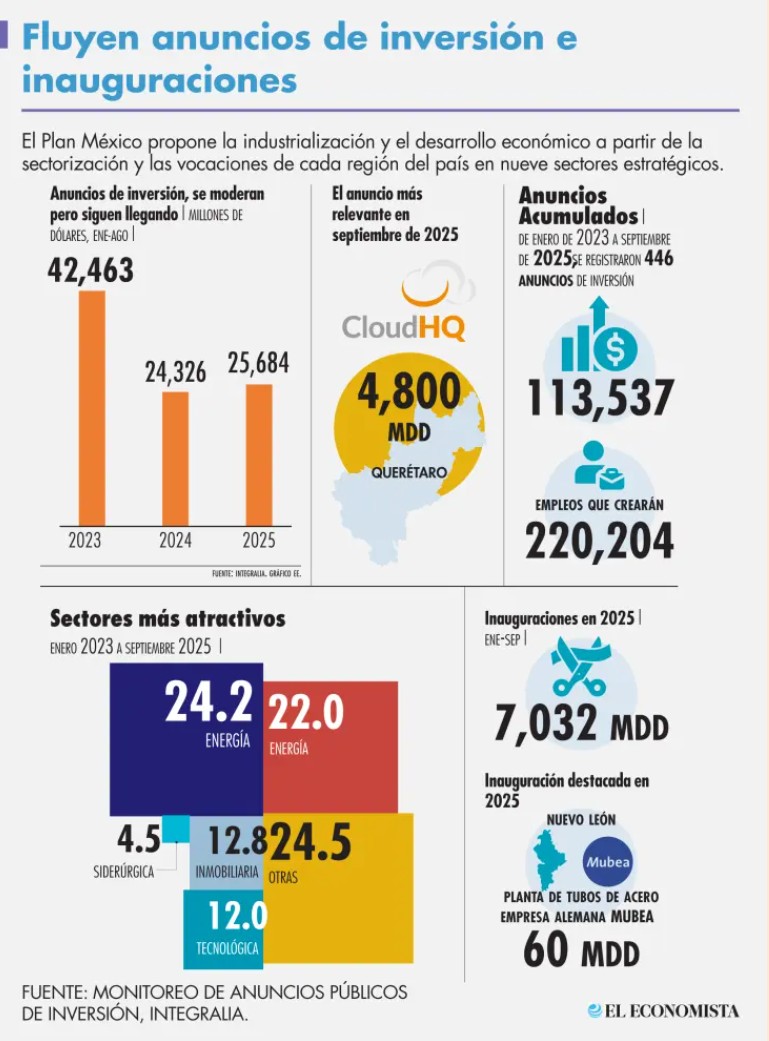
Based on public investment monitoring data covering January 2023 to September 2025, total announced investment projects reached USD 113.5 billion, corresponding to 446 announcements and the creation of more than 220,000 jobs.
However, the pace has moderated:
- 2023: USD 42.5 billion in announcements
- 2024: USD 24.3 billion
- 2025 (Jan–Sep): USD 25.7 billion
According to Integralia, investment announcements in the first nine months of 2025 were approximately 40% lower than in the same period of 2023, yet they continue to grow despite tariff pressure.
This moderation reflects caution—not loss of confidence.
Inventory Front-Loading and Trade Distortions
One explanation for recent volatility lies in inventory behavior. Following the confirmation of Donald Trump’s return to the U.S. presidency, many U.S. companies accelerated purchases, building inventories in anticipation of new tariffs.
This front-loading temporarily boosted Mexican exports in early 2025, creating what analysts describe as atypical trade behavior. While this effect is expected to normalize, it underscores Mexico’s role as a buffer economy during trade transitions.
Sectoral Shift: Beyond Automotive Manufacturing
While manufacturing remains central, Mexico is actively diversifying its industrial strategy. Under the Plan México, the government is promoting sector-based development aligned with regional strengths, with particular emphasis on:
- Energy
- Technology and data infrastructure
- Pharmaceuticals and medical devices
- Advanced manufacturing
This diversification is designed to reduce overreliance on a single industrial pillar and to strengthen Mexico’s position across global value chains.
Industrialization by Regional Vocation
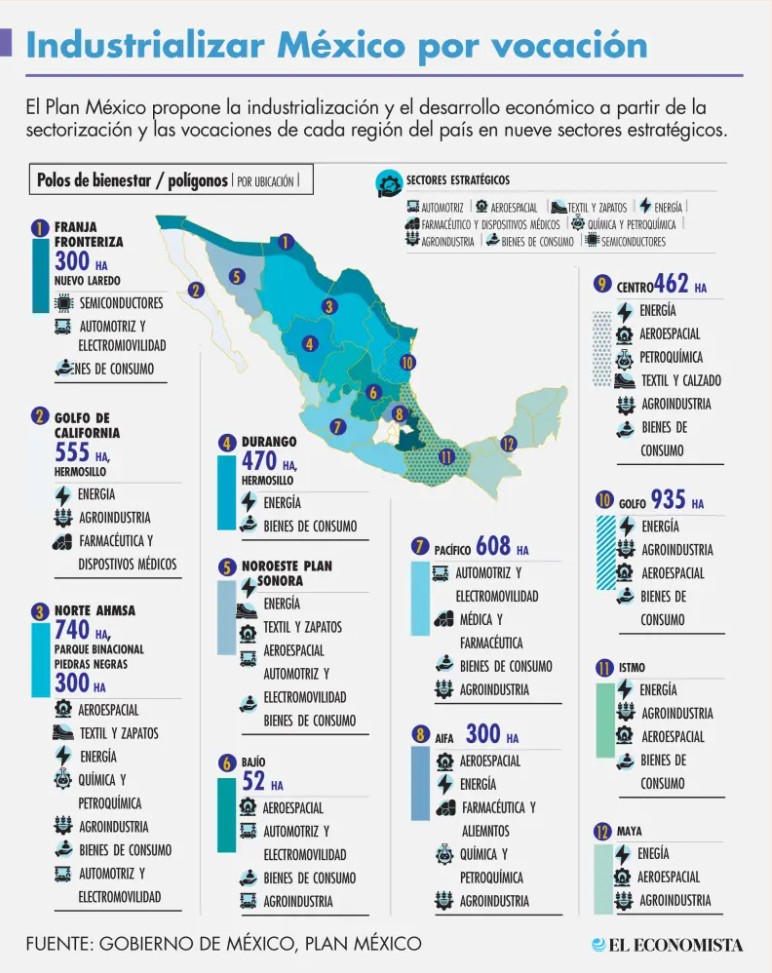
The Plan México framework organizes industrial development through regional specialization, assigning strategic sectors to defined industrial corridors and development zones.
Examples include:
- Northern Border Region: Semiconductors, automotive, electromobility
- Bajío: Automotive, aerospace, consumer goods
- Pacific Corridor: Medical devices, pharmaceuticals, agribusiness
- Gulf & Isthmus Regions: Energy, petrochemicals, agroindustry
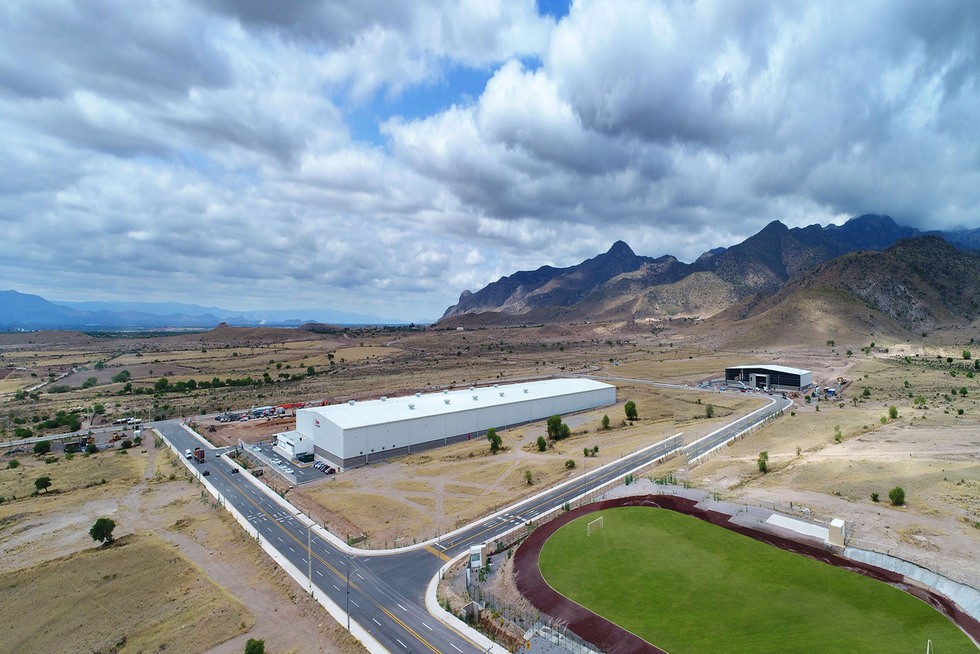
This approach links investment attraction directly to location logic, infrastructure availability, and workforce capabilities—key considerations for long-term investors.
2025 Investment Highlights: What Capital Is Targeting
Several major projects announced or advanced in 2025 illustrate this selective momentum:
- CloudHQ announced a USD 4.8 billion data center megacampus in Querétaro, expanding earlier commitments totaling USD 3.6 billion.
- ODATA, a subsidiary of Aligned Data Centers, committed USD 3 billion to a high-capacity data center campus with up to 300 MW of IT power.
- LG Innotek is investing MXN 3.5 billion in Querétaro to expand production of automotive components.
- Hengli Hydraulics announced a USD 325 million investment in Nuevo León, creating up to 800 jobs in phases.
- NHK Spring expanded its Guanajuato operations with a USD 55 million investment in electric motor components.
These projects highlight a clear trend: capital is flowing into power-intensive, technology-driven, and high-value manufacturing sectors, often within established industrial parks.
Nearshoring Is Slower—but More Disciplined
As noted by Alberto Quiroz, nearshoring remains active, even if it has lost its headline-driven momentum.
Companies are now:
- Waiting for regulatory clarity (notably in pharmaceuticals and medical devices)
- Prioritizing execution-ready locations
- Aligning investments with long-term North American supply chains
This shift favors projects with infrastructure certainty, particularly where energy, water, and logistics capacity are already secured.
What This Means for Investment Decisions
The current environment rewards precision over speed. Investors are less willing to bet on undeveloped locations or speculative capacity. Instead, they focus on:
- Regions with defined industrial vocation
- Locations integrated into logistics corridors
- Projects aligned with USMCA-compatible supply chains
Mexico’s ability to maintain attractiveness depends less on incentives and more on execution reliability.
Outlook: Stability Through Diversification
Mexico’s investment appeal has not disappeared—it has matured. Nearshoring is no longer driven by urgency alone, but by strategic alignment.
By diversifying its industrial base, strengthening regional specialization, and maintaining integration with North American markets, Mexico continues to offer a credible platform for long-term investment, even amid global uncertainty.
Decision Takeaway
Mexico remains investable—not because uncertainty has faded, but because companies are adapting their strategies. The transition from volume-driven nearshoring to selective, sector-focused investment is underway.
For investors, the key question is no longer whether Mexico is attractive, but where and how execution can be achieved with certainty.
FAQ
Is Mexico still attractive for foreign investment in 2025?Yes, particularly in energy, technology, and advanced manufacturing.
Has nearshoring stopped?No. It has slowed and become more selective.
Which sectors are attracting investment now?Energy, data centers, automotive components, medical devices.
Why are investment announcements lower than in 2023?Due to trade uncertainty and inventory front-loading effects.
What role does Plan México play?It aligns industrial development with regional strengths and strategic sectors.