Ports in Mexico: What the Decline Means for Nearshoring and Logistics Strategy

Executive Summary
Recent data shows that ports in Mexico experienced a decline of approximately 8.8% in cargo volume in 2025. While this may appear as a negative signal, the underlying dynamics tell a different story.
Key insights:
- The decline is driven by global trade uncertainty and reduced international cargo flows
- Nearshoring in Mexico is shifting supply chains toward regional and land-based logistics
- Domestic maritime transport is increasing, reflecting stronger internal distribution
- Port performance varies significantly depending on region and cargo type
The key takeaway:The evolution of ports in Mexico reflects a broader transformation of logistics Mexico and supply chain Mexico, not a structural decline in industrial activity.
Introduction
Ports in Mexico have long been a critical component of global trade, supporting both imports of raw materials and exports of manufactured goods.
However, recent shifts in trade patterns are changing how logistics Mexico functions.
As highlighted in , cargo movement across ports in Mexico declined in 2025, driven by external economic pressures and changes in global supply chains.
For companies evaluating manufacturing in Mexico, this raises an important strategic question:
How should logistics and site selection adapt to these new realities?
Ports in Mexico: Performance and Structural Changes
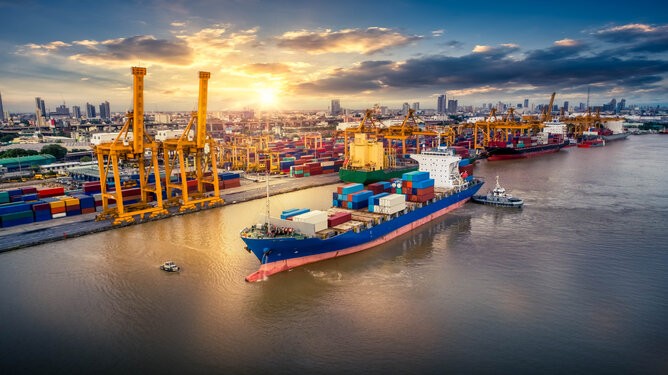
In 2025, ports in Mexico handled approximately 248.7 million tons of cargo, representing a decline of -8.8% year-over-year.
Major ports such as:
- Manzanillo
- Veracruz
- Lázaro Cárdenas
All recorded decreases in volume.
This indicates a broader shift in supply chain Mexico, rather than an isolated issue.
Logistics Mexico: Declining International Trade vs. Domestic Growth
The most significant changes occurred in international cargo:
- Exports declined by -15.2%
- Imports declined by -9.1%
At the same time:
- Domestic maritime transport increased by +3.7%
This suggests that logistics Mexico is becoming more regionally focused.
Key drivers include:
- Trade policy uncertainty
- Tariff risks
- Shifting global demand
- Nearshoring Mexico strategies
Nearshoring Mexico Is Redefining Ports in Mexico
Nearshoring Mexico is fundamentally changing how supply chains operate.
Instead of relying on long-distance imports:
- Companies are producing closer to the U.S.
- Supply chains are becoming shorter and more regional
- Land-based logistics are gaining importance
As a result, ports in Mexico are no longer the only critical logistics nodes.
Implication:
A decline in port volume can occur alongside growth in manufacturing in Mexico.
Supply Chain Mexico: The Role of Cargo Composition
Another important factor influencing ports in Mexico is cargo composition.
Breakdown:
- Oil and derivatives: 35.8%
- Container cargo: 23.7%
- Mineral bulk: 16.6%
The largest decline occurred in:
- Oil and derivatives: -13.4%
This highlights that ports in Mexico are still heavily influenced by the energy sector, not just industrial production.
Regional Differences in Ports in Mexico
Not all ports in Mexico are affected equally.
Some smaller ports showed growth:
- Topolobampo
- Mazatlán
- Dos Bocas
Others experienced sharp declines.
Implication:
Logistics Mexico is highly regionalized, and companies must carefully evaluate which corridors align with their operations.
What This Means for Companies Expanding into Mexico
The evolution of ports in Mexico has direct implications for investment decisions.
Logistics Strategy Must Go Beyond Ports
Companies must evaluate:
- Border proximity to the U.S.
- Highway and rail connectivity
- Industrial cluster access
Ports remain important—but are now part of a broader supply chain Mexico strategy.
Northern Mexico Gains Strategic Importance
With nearshoring Mexico, regions closer to the U.S. border are gaining relevance:
- Monterrey
- Tijuana
- Ciudad Juárez
These locations benefit from:
- Faster delivery times
- Reduced logistics costs
- Strong integration with U.S. supply chains
Multi-Modal Logistics Becomes Essential
Companies should avoid relying on a single logistics channel.
Instead, successful strategies include:
- Combining ports, rail, and road transport
- Diversifying supply routes
- Building redundancy into logistics Mexico systems
Strategic Insight: Ports in Mexico Are Evolving—Not Declining
The decline in ports in Mexico does not indicate weakness.
Instead, it reflects a transition toward:
- Regionalized supply chains
- Nearshoring-driven production
- Integrated logistics networks
For companies, the key is understanding how supply chain Mexico is evolving—and adapting accordingly.
Conclusion
Ports in Mexico remain a critical part of the country’s industrial ecosystem, but their role is changing.
The shift toward nearshoring Mexico and regional supply chains means that:
- Logistics strategies must be more flexible
- Site selection must consider multiple factors
- Port data must be interpreted in context
For companies expanding into manufacturing in Mexico, success depends on aligning logistics strategy with these evolving dynamics.
FAQ
Why are ports in Mexico experiencing declining activity?
Due to global trade uncertainty, reduced international cargo, and shifts toward nearshoring Mexico.
Are ports in Mexico still important for manufacturing?
Yes, but they are now part of a broader logistics Mexico strategy.
How does nearshoring Mexico impact ports?
It reduces reliance on long-distance shipping and increases regional supply chain activity.
What should companies consider beyond ports in Mexico?
Infrastructure, proximity to the U.S., and integration into supply chain Mexico.
Do declining ports mean weaker manufacturing in Mexico?
No, manufacturing in Mexico continues to grow despite changes in port activity.
Why Mexecution
The transformation of ports in Mexico highlights a critical reality:Logistics is no longer a simple factor—it is a strategic decision.
Understanding how logistics Mexico and supply chain Mexico are evolving is essential for selecting the right location and ensuring long-term operational success.
Mexecution supports companies with:
- Data-driven site selection aligned with logistics and supply chain requirements
- Identification of optimal locations based on infrastructure, connectivity, and regional advantages
- Transparent access to industrial real estate opportunities across Mexico
- Independent advisory without commission-driven bias
Expanding into manufacturing in Mexico requires more than finding a facility—it requires positioning your operation within the right logistics ecosystem.
Making the right decision early can significantly improve efficiency, reduce risk, and strengthen your competitive advantage.