Nearshoring in Mexico 2026: Why the Bajío and Northern States Continue Leading Industrial Investment

Executive Summary
Nearshoring in Mexico continues reshaping the country’s industrial landscape in 2026. While global investment decisions remain cautious due to tariffs, geopolitical uncertainty, and slower global manufacturing activity, the Bajío and northern industrial corridors continue attracting the majority of new industrial projects.
States such as Querétaro, Nuevo León, Tamaulipas, Guanajuato, and Jalisco remain the preferred destinations for foreign manufacturers because they offer mature industrial ecosystems, export infrastructure, skilled labor, and strong logistics connectivity to the United States.
For international companies evaluating manufacturing in Mexico or industrial real estate in Mexico, the message is increasingly clear: success depends less on choosing the cheapest region and more on selecting the right industrial ecosystem.
Why Nearshoring in Mexico Continues Accelerating
Global manufacturers continue restructuring supply chains to reduce dependence on Asia and improve operational resilience.
Several factors continue driving nearshoring investment in Mexico:
- USMCA trade advantages
- proximity to the United States
- geopolitical diversification
- transportation cost reduction
- faster delivery times
- supply chain resilience
- tariff mitigation strategies
Although Mexico experienced slower investment announcement growth during early 2026, industrial relocation activity remains strong in regions with established export infrastructure and manufacturing experience.
The Bajío and Northern Mexico Continue Dominating Investment
Most new industrial investment announcements remain concentrated in:
- Querétaro
- Nuevo León
- Tamaulipas
- Guanajuato
- Coahuila
- Chihuahua
- Jalisco
These regions benefit from decades of industrial development and integration into North American supply chains.
Figure 1 – Industrial Investment Announcements in Mexico (2026)
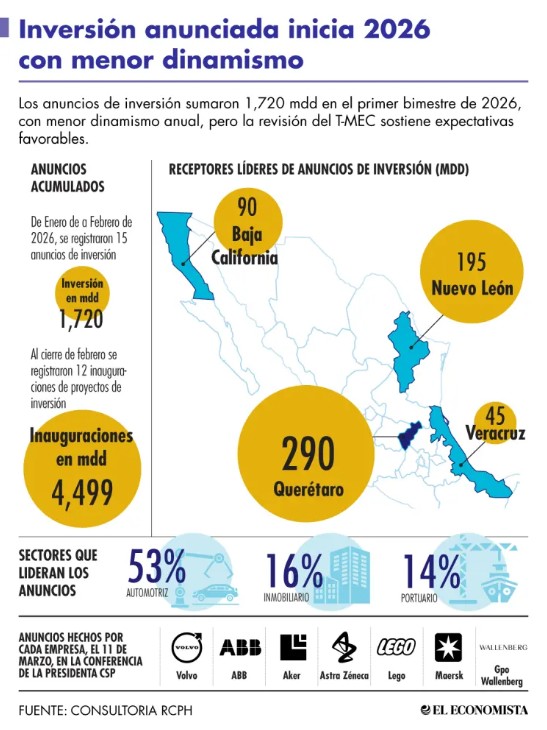
Industrial investment announcements in Querétaro and Nuevo León Mexico during 2026
The figure shows that:
- Querétaro attracted approximately USD 290 million in announcements
- Nuevo León reached approximately USD 195 million
- Baja California received approximately USD 90 million
- Veracruz recorded approximately USD 45 million
The largest investment sectors included:
- automotive manufacturing
- industrial real estate
- port infrastructure
This confirms that export-oriented manufacturing remains one of the strongest drivers of industrial growth in Mexico.
Why Foreign Manufacturers Prefer These Industrial Corridors
Mature Industrial Ecosystems
One of the main reasons companies continue selecting the Bajío and northern Mexico is ecosystem maturity.
These regions already offer:
- supplier networks
- logistics providers
- industrial developers
- customs infrastructure
- engineering talent
- export experience
For foreign investors, this significantly lowers operational risk and accelerates ramp-up timelines.
Rather than building a supply chain from zero, companies can integrate directly into existing manufacturing clusters.
Strong Export Infrastructure
Northern Mexico remains highly attractive because of direct U.S. connectivity.
States such as:
- Nuevo León
- Coahuila
- Chihuahua
- Tamaulipas
- Baja California
benefit from:
- border access
- rail infrastructure
- highway connectivity
- customs operations
- cross-border logistics expertise
Meanwhile, the Bajío region offers strategic connectivity to:
- central Mexico
- Pacific ports
- automotive corridors
- and major consumer markets.
This makes the region highly attractive for manufacturers operating under:
- just-in-time production
- regionalized supply chains
- and USMCA compliance strategies.
Industrial Real Estate Availability
Industrial real estate availability remains a critical factor for nearshoring projects.
The strongest industrial regions continue offering:
- Class A industrial buildings
- build-to-suit developments
- expansion land
- utility infrastructure
- scalable industrial parks
This is particularly important for manufacturers requiring:
- high electrical capacity
- logistics access
- expansion flexibility
- or specialized industrial specifications.
Regions without modern industrial infrastructure continue struggling to attract large-scale manufacturing investment.
Querétaro Continues Strengthening Its Position
Querétaro remains one of Mexico’s strongest advanced manufacturing hubs.
The state continues attracting:
- aerospace companies
- automotive suppliers
- medical device manufacturers
- electronics companies
- and technology operations.
Several important investment announcements during 2026 reinforced this position.
Examples include:
- Abbott investing USD 200 million in medical devices
- LS Cable & System expanding for the USMCA market
- Astellas strengthening operational capabilities from Querétaro
Querétaro’s competitive advantages include:
- central location
- engineering talent
- high-quality industrial parks
- safety perception
- and operational stability.
For many international firms, Querétaro represents a balance between:
- scalability
- operational quality
- and long-term investment stability.
Nuevo León Remains Mexico’s Industrial Powerhouse
Nuevo León continues leading industrial investment in Mexico.
The Monterrey metropolitan area remains one of Latin America’s most developed industrial ecosystems due to:
- supplier density
- advanced manufacturing capabilities
- executive talent
- logistics infrastructure
- and U.S. market access.
Major projects announced in 2026 included:
- Volvo Group’s USD 1 billion truck manufacturing plant
- Munters’ industrial expansion
- EAM-Mosca’s manufacturing growth in Monterrey.
Monterrey continues positioning itself as Mexico’s primary hub for:
- industrial-scale manufacturing
- advanced production
- logistics operations
- and multinational expansion.
Tamaulipas Benefits from Cross-Border Manufacturing
Tamaulipas continues strengthening its role within North American supply chains.
The state benefits from:
- direct border connectivity
- export-oriented manufacturing
- logistics infrastructure
- and energy-related operations.
Suprajit’s expansion in Matamoros demonstrates how automotive suppliers continue investing near the U.S. border.
For manufacturers requiring:
- rapid cross-border transportation
- supplier integration
- and export efficiency,
Tamaulipas remains strategically attractive.
Why Southern Mexico Still Faces Challenges
Despite long-term infrastructure potential, most nearshoring investment continues concentrating in established industrial corridors rather than southern Mexico.
The primary challenges remain:
- weaker industrial ecosystems
- limited supplier density
- infrastructure gaps
- and lower logistics integration.
Foreign manufacturers typically prioritize:
- operational certainty
- supply chain maturity
- labor availability
- and export connectivity.
As a result, investment continues favoring regions with established manufacturing foundations.
Industrial Corridors Matter More Than Individual Cities
One major trend shaping manufacturing in Mexico is the growing importance of industrial corridors.
Rather than evaluating isolated cities, investors increasingly analyze:
- supplier ecosystems
- logistics routes
- labor markets
- highway access
- rail connectivity
- and regional scalability.
Examples of major industrial corridors include:
- Monterrey–Saltillo
- Querétaro–Guanajuato
- Guadalajara–Bajío
- northern border manufacturing corridors
These integrated ecosystems create:
- economies of scale
- stronger supplier networks
- operational flexibility
- and lower supply chain risk.
What Foreign Investors Should Consider
Infrastructure Matters More Than Incentives
Low costs alone rarely determine long-term manufacturing success.
Companies should prioritize:
- logistics infrastructure
- utilities
- labor depth
- industrial park quality
- and supplier ecosystems.
Site Selection Requires Regional Analysis
Every industrial region in Mexico offers different advantages.
Examples:
- Monterrey for industrial scale
- Querétaro for advanced manufacturing
- Tamaulipas for border logistics
- Guanajuato for automotive production
- Jalisco for electronics and technology
Proper site selection requires evaluating operational requirements beyond rental cost alone.
Nearshoring Is Becoming More Strategic
Manufacturers are increasingly prioritizing:
- resilience
- geopolitical stability
- regional integration
- and transportation reliability.
This trend continues strengthening Mexico’s role within North American manufacturing.
Conclusion
Nearshoring in Mexico remains heavily concentrated in the Bajío and northern industrial corridors because these regions provide the infrastructure, manufacturing experience, and logistics connectivity global companies require.
Querétaro, Nuevo León, Tamaulipas, Guanajuato, and Jalisco continue strengthening their positions as strategic industrial hubs for North America.
For foreign investors and manufacturers, the key lesson is clear:
The most competitive manufacturing operations in Mexico are typically built within mature industrial ecosystems rather than isolated low-cost locations.
As supply chains continue regionalizing across North America, Mexico’s strongest industrial corridors are likely to remain the primary beneficiaries of future manufacturing investment.
FAQ
Why is nearshoring concentrated in northern Mexico and the Bajío?
These regions already offer mature industrial infrastructure, supplier ecosystems, export connectivity, and experienced manufacturing labor.
Which Mexican states attract the most industrial investment?
Querétaro, Nuevo León, Tamaulipas, Guanajuato, Coahuila, and Jalisco remain among the strongest industrial investment destinations in Mexico.
Why is Querétaro attractive for manufacturing?
Querétaro offers:
- advanced manufacturing clusters
- engineering talent
- industrial parks
- logistics connectivity
- and operational stability.
Why do foreign companies choose Monterrey?
Monterrey provides:
- large industrial ecosystems
- supplier density
- executive talent
- logistics infrastructure
- and direct U.S. market access.
Is nearshoring still growing in Mexico?
Yes. Despite slower global industrial activity and tariff uncertainty, nearshoring investment in Mexico continues growing in strategic industrial corridors.