Skilled Labor in Mexico: Opportunity and Competition in Industrial Corridors

Executive Summary
Mexico offers one of the most attractive labor markets for international companies expanding manufacturing operations.
Key takeaways:
- Mexico has a young and motivated workforce (average age ~29)
- Skilled labor is highly concentrated in the industrial corridor
- Companies must invest in in-house training and workforce development
- High employee turnover is a structural challenge
- Competition for talent is increasing due to nearshoring in Mexico
The key insight:Labor availability is a major advantage—but talent management strategy determines long-term success.
Introduction
For companies evaluating manufacturing in Mexico, labor availability is one of the most critical decision factors.
Mexico is widely recognized for:
- Strong workforce availability
- High operational flexibility
- Competitive labor costs
However, the reality on the ground is more nuanced.
Companies entering the market must understand:
- Where talent is located
- How competitive the labor market is
- What challenges exist in training and retention
Mexico’s Workforce Advantage: Young, Engaged, and Growing
Mexico’s demographic structure provides a clear advantage for industrial expansion.
Key facts:
- Average age: ~29 years
- Large and growing labor force
- Strong willingness to work in manufacturing environments
International companies consistently report:
- High employee engagement
- Strong adaptability in production environments
- Capability to support labor-intensive processes
This is particularly relevant for industries such as:
- Automotive
- Aerospace
- Electronics
- Advanced manufacturing
As a result, skilled labor in Mexico is a central driver behind nearshoring decisions.
The Industrial Corridor: Where Talent Is Concentrated
The availability of skilled labor in Mexico is not evenly distributed.
The majority of qualified workers are concentrated in a key industrial corridor:
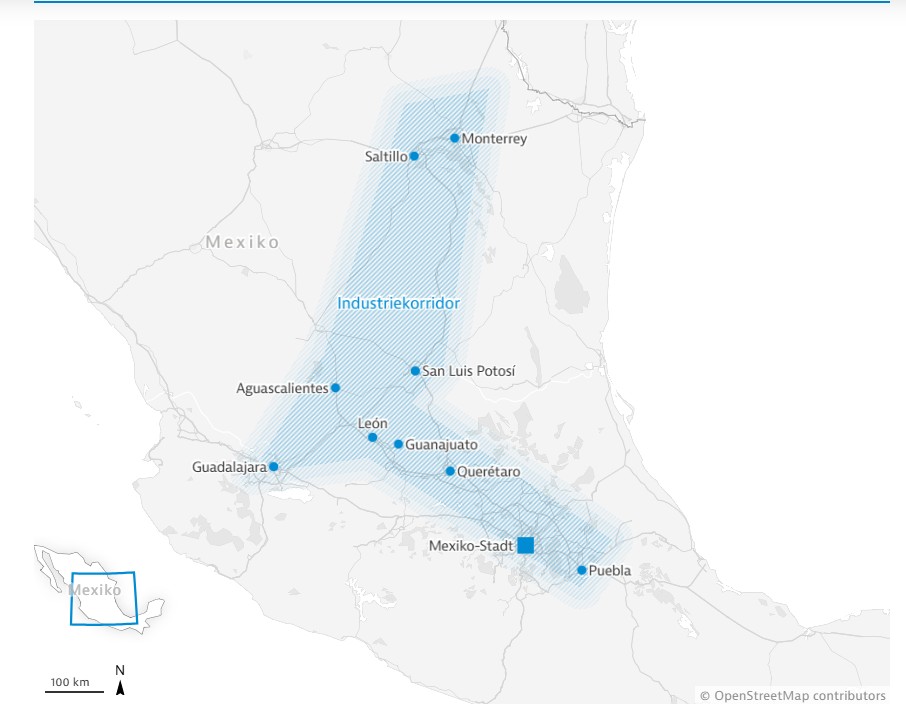
Source: GTAI
This corridor stretches across major industrial hubs:
- Monterrey & Saltillo (North)
- Bajío region (Querétaro, Guanajuato, San Luis Potosí)
- Guadalajara (West)
- Mexico City metropolitan area
- Puebla (Southeast of Mexico City)
These regions offer:
- Established industrial ecosystems
- Access to experienced manufacturing labor
- Proximity to suppliers and logistics infrastructure
However, this concentration also leads to one key issue:
Intense competition for talent.
The Reality: Skilled Labor Shortages in Key Regions
While Mexico has a large workforce, qualified technical talent is limited in high-demand regions.
In industrial hubs:
- Multiple global companies compete for the same talent pool
- Demand often exceeds supply
- Hiring cycles can become longer
Additionally:
- Mexico’s unemployment rate is low (~2.6%)
- Informality remains high (~55%), limiting access to structured labor
Implication for companies:
Entering the right location is not just about cost—it is about access to sustainable labor pools.
Training Is Not Optional: The Need for In-House Development
One of the most important realities:
Mexico’s education system does not always provide job-ready technical talent.
As a result:
- Companies must invest in internal training programs
- Onboarding timelines can be longer
- Skill development becomes part of operations
Many companies implement:
- Technical academies
- Dual education programs
- Partnerships with local institutions
The dual education system—adapted from German models—exists but is not yet universally scaled.
Conclusion:
Workforce development is a strategic function, not an HR task.
High Employee Turnover: A Structural Challenge
A defining characteristic of the Mexican labor market is high employee mobility.
Key dynamics:
- Skilled workers receive frequent competing offers
- Salary increases drive job changes
- Trained employees become highly attractive in the market
In some cases:
- Competitors even compensate employees for training costs
This creates challenges for:
- Workforce stability
- Long-term productivity
- Knowledge retention
Retention Strategy: Trust and Culture Matter
Successful companies in Mexico approach workforce management differently.
Key success factors:
- Building trust-based relationships
- Encouraging open communication
- Providing recognition and feedback
Cultural insight:
Employees may avoid raising issues to prevent conflict or negative perception.
Therefore, companies must:
- Create psychologically safe environments
- Encourage transparency in operations
- Invest in leadership development
Nearshoring Is Intensifying the War for Talent
The rise of nearshoring in Mexico is accelerating competition for skilled labor.
As more companies enter:
- Demand for engineers, technicians, and operators increases
- Wage pressure rises in key regions
- Talent shortages become more visible
This is especially critical in:
- Monterrey
- Querétaro
- Bajío region
Implication:
Labor strategy is now a core component of site selection in Mexico.
Strategic Insight: Labor Availability Is Location-Dependent
One of the most common mistakes companies make:
Assuming labor availability is uniform across Mexico.
Reality:
- Some regions are saturated
- Others still offer untapped labor pools
Therefore, site selection Mexico must include:
- Labor market analysis
- Competition mapping
- Long-term workforce planning
Conclusion
Mexico remains one of the most attractive labor markets globally for manufacturing.
However, success depends on understanding key realities:
- Skilled labor is concentrated geographically
- Training is required
- Competition for talent is increasing
- Retention strategies are essential
For companies entering manufacturing in Mexico, labor is not just a resource—it is a strategic variable.
FAQ
Is skilled labor in Mexico easy to find?In general yes, but in key industrial regions competition is very high.
Where is skilled labor concentrated in Mexico?Primarily in the industrial corridor from Monterrey to central Mexico.
Do companies need to train employees in Mexico?Yes, most companies implement internal training programs.
Why is employee turnover high in Mexico?Because skilled workers receive frequent competing offers.
How does nearshoring affect the labor market?It increases demand and intensifies competition for talent.
Why Mexecution
Access to skilled labor in Mexico is one of the most critical success factors for industrial expansion.
However, labor availability is highly location-specific and directly linked to:
- Industrial clusters
- Competition density
- Infrastructure and ecosystem maturity
Mexecution supports companies with:
- Data-driven site selection Mexico based on labor availability
- Identification of locations with sustainable workforce access
- Transparent insights into industrial regions and talent dynamics
- Independent advisory without commission-driven bias
Choosing the right location is not just about real estate—it is about securing your workforce.