US Tariffs Are Reshaping Automotive Supply Chains: Why Staying Competitive Means Producing in Mexico
Executive Summary
U.S. tariff policy has become a structural supply-chain issue for the automotive sector. Since 2025, Section 232 tariffs on automobiles and many auto parts have raised the cost of importing finished vehicles and components into the United States, while USMCA-compliant production has remained the main path to preserve lower-duty access. Official U.S. guidance confirms that Section 232 auto tariffs remain in force, and CBP provides special treatment mechanisms for qualifying USMCA vehicles and parts.
That is why the competitive question for OEMs and suppliers is no longer just labor cost. It is now about regional content, tariff exposure, supplier localization, and lead-time control. Mexico is central to that shift. It already has the industrial base, supplier depth, and cross-border integration needed to support a North American automotive footprint, and the 2026 USMCA review is now explicitly focusing on rules of origin, production within the region, and supply-chain security.
For suppliers that still depend heavily on Europe or Asia, the message is increasingly clear: if you want to remain relevant in North American automotive supply chains, producing in Mexico is becoming less of an option and more of a strategic requirement.
From NAFTA to USMCA: Why the Rules Matter More Now
North American automotive integration did not begin with the current tariff cycle. It was built under NAFTA and then tightened under USMCA. The biggest difference is that USMCA raised the compliance bar for automotive trade.
Official U.S. material states that USMCA requires 75% regional value content for vehicles, with similarly higher thresholds for key parts. It also introduced labor value content rules designed to push more value-added production into North America.
That matters because the old model of assembling vehicles in North America while sourcing a large share of components globally is under more pressure than before. Companies that fail to localize enough content are more exposed to tariffs, compliance friction, and future policy tightening.
What Changed Under the New Tariff Environment
The current disruption is not theoretical. It is already embedded in the tariff structure.
The White House imposed 25% Section 232 tariffs on automobiles in March 2025, and the measure was later amended. CBP’s auto tariff guidance confirms that the regime remains active and that special treatment depends on USMCA eligibility and content calculations.
At the same time, CBP also states that goods already subject to Section 232 auto duties are excluded from overlapping IEEPA reciprocal tariffs, which means Section 232 remains the main tariff lens for many automotive imports.
In practical terms, this has created a new operating reality for the industry:
- imported automotive content from outside North America has become more expensive
- rules-of-origin compliance has become more valuable
- supplier footprints are being reassessed at the regional level
- tariff engineering is no longer enough without physical supply-chain localization
Why Mexico Matters More Than Ever
Mexico is not suddenly relevant. It has been one of the pillars of North American automotive manufacturing for decades. What has changed is the urgency.
Mexico already offers what many OEMs and Tier 1s need right now:
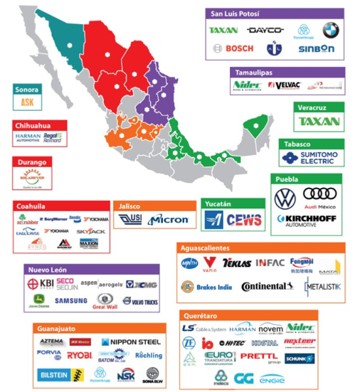
- a mature manufacturing base
- direct integration with U.S. and Canadian production networks
- skilled labor for automotive, electronics, and industrial processes
- lower logistics risk than transoceanic supply chains
- the ability to help increase North American content under USMCA
The 2026 USMCA review process makes that even more important. Reuters reports that U.S. and Mexican negotiators will begin formal discussions in March 2026 with a focus on reducing dependence on imports from outside the region, strengthening rules of origin, boosting regional production, and improving supply-chain security.
That is the exact policy direction that favors production in Mexico.
The Supply-Chain Logic: Why Suppliers Need a Mexico Strategy
The real impact of tariffs is not only on OEMs. It is strongest in the supplier network.
Tier 2, Tier 3, and Tier 4 suppliers are now under more pressure because OEMs and Tier 1s are trying to increase regional content without disrupting quality or delivery. Reuters has reported that Mexico’s auto industry is already warning about stricter scrutiny on Asian content and that smaller regional suppliers need to be developed faster.
That creates a clear market signal:
- OEMs want more North American content
- Tier 1s want more local sourcing
- suppliers without a North American footprint risk losing future RFQs
- suppliers that invest in Mexico can become part of the preferred regional chain
This is especially relevant for European suppliers that still serve North America from overseas plants. The longer they wait, the greater the chance that a competitor localizes first and secures customer programs inside the USMCA zone.
What “Producing in Mexico” Solves
Producing in Mexico does not eliminate all tariff risk. But it solves several structural problems at once.
1. It reduces tariff exposure
USMCA-compliant production remains the main framework for preserving preferential access to the U.S. market. Official CBP and USTR documents make clear that compliance with origin rules is central to how tariffs are applied in automotive trade.
2. It shortens supply chains
A Mexico footprint allows suppliers to serve the U.S. and Canada with shorter lead times, less ocean freight dependency, and more flexible replenishment cycles.
3. It improves customer stickiness
OEMs and Tier 1s increasingly want suppliers close to assembly and subassembly operations. Local presence improves engineering response, quality coordination, and launch execution.
4. It supports future compliance
If the 2026 review leads to tighter industrial goods rules or stronger regional-content enforcement, suppliers already operating in Mexico will be in a much stronger position than those still shipping from Europe or Asia.
Current Developments the Industry Cannot Ignore
Several current signals make this topic more urgent than it was a year ago.
First, the U.S. International Trade Commission has launched a review of USMCA automotive rules of origin, explicitly examining competitiveness and current relevance. Reuters reports that major automakers support extending USMCA and see it as vital for North American production.
Second, the formal USMCA review process is starting now, with supply-chain security and regional production already at the center of U.S.-Mexico talks.
Third, Mexico’s own industry organizations have been warning that the market outlook is becoming more complex, especially around Asian content, trucks, and deeper supplier localization.
Together, these developments point in one direction: North American automotive supply chains are being pushed toward deeper regionalization.
What This Means for OEMs and Suppliers
For OEMs, the priority is protecting program profitability and avoiding avoidable tariff cost.
For Tier 1s, the priority is keeping supplier networks compliant, resilient, and geographically aligned with customers.
For Tier 2–Tier 4 suppliers, the priority is simpler: be where your customers need you to be.
That increasingly means:
- manufacturing in Mexico
- warehousing in Mexico
- localizing selected component families
- building a USMCA-compatible supply model
Companies that continue to rely too heavily on long-distance sourcing may remain technically competitive on paper, but commercially weaker in the eyes of North American customers.
Conclusion
The automotive tariff environment is not just a trade policy issue anymore. It is now a supply-chain design issue.
USMCA remains the key framework protecting North American trade, but the bar for compliance and regional content is becoming more important, not less. Current policy discussions, tariff enforcement, and automotive rules-of-origin reviews all point toward one strategic conclusion: North American production is gaining importance, and Mexico is central to that shift.
For suppliers that want to stay competitive, producing in Mexico is no longer only about cost. It is about protecting market access, meeting customer localization targets, and building a supply chain that can still perform under tighter trade rules.
FAQ
Are U.S. automotive tariffs still active?
Yes. Section 232 tariffs on automobiles and many automotive parts remain active, with CBP continuing to publish guidance and FAQs on their application.
Why is Mexico important under USMCA?
Mexico is one of the three USMCA countries and already hosts a large automotive manufacturing base. Producing in Mexico can help companies increase North American content and improve supply-chain resilience.
What is the key USMCA rule for vehicles?
Official U.S. information states that vehicles must meet a 75% regional value content threshold, along with additional requirements such as labor value content, to benefit from USMCA treatment.
What is changing in 2026?
The USMCA review process is beginning, and current talks are focusing on rules of origin, reducing non-regional dependency, and strengthening supply-chain security.