USMCA, Nearshoring and Geopolitics: Why Mexico Is Becoming North America’s Manufacturing Platform

Executive Summary
North America is entering a new industrial era driven by geopolitical tensions, supply chain restructuring, tariffs on Asian imports, and growing pressure to secure regional manufacturing capacity. In this environment, Mexico is no longer viewed simply as a low-cost production destination. It is increasingly becoming the strategic manufacturing platform of North America.
The upcoming review of the United States-Mexico-Canada Agreement (USMCA), combined with infrastructure investment and industrial expansion across Mexico, is reinforcing the country’s role within global supply chains. For manufacturers serving the United States and Canada, Mexico offers a combination of:
- proximity
- industrial ecosystems
- export infrastructure
- and operational resilience.
As global companies continue prioritizing supply chain security over pure labor arbitrage, nearshoring in Mexico is evolving into a long-term strategic manufacturing shift.
Why North America Is Reinforcing Regional Supply Chains
Over the past several years, global manufacturers have faced repeated disruptions:
- U.S.-China trade tensions
- tariffs
- shipping bottlenecks
- semiconductor shortages
- geopolitical conflicts
- and energy volatility.
These disruptions exposed the vulnerabilities of highly globalized supply chains that depend heavily on distant production hubs.
As a result, companies increasingly prioritize:
- regional manufacturing
- supply chain resilience
- logistics control
- and operational continuity.
This transformation is accelerating investment across North America and strengthening Mexico’s role inside regional manufacturing networks.
USMCA Is the Foundation of North American Manufacturing
The USMCA agreement has become one of the most important industrial trade frameworks in the world.
The agreement supports:
- tariff stability
- integrated manufacturing
- cross-border logistics
- supplier coordination
- and investment certainty.
Despite uncertainty surrounding the upcoming USMCA review, most analysts and financial institutions expect:
- continuity
- modernization
- and deeper regional integration,
rather than disruption.
Financial institutions and industrial organizations increasingly view North American manufacturing integration as strategically necessary due to:
- geopolitical competition
- supply chain diversification
- energy security
- and industrial resilience.
This explains why many multinational companies continue expanding operations in Mexico despite global uncertainty.
Mexico Is Becoming a Strategic Manufacturing Platform
Mexico’s industrial growth is the result of decades of manufacturing integration with the United States and Canada.
The country has developed:
- industrial parks
- supplier ecosystems
- logistics infrastructure
- engineering talent
- and export-oriented manufacturing capabilities.
Industrial regions such as:
- Monterrey
- Querétaro
- Guanajuato
- Saltillo
- Tijuana
- Ciudad Juárez
- and Guadalajara
have evolved into highly specialized manufacturing ecosystems directly connected to North American production networks.
This industrial maturity represents one of Mexico’s strongest competitive advantages.
Nearshoring Is Evolving Beyond Labor Costs
Nearshoring is no longer driven only by wage arbitrage.
Manufacturers increasingly evaluate:
- logistics reliability
- transportation costs
- geopolitical exposure
- delivery speed
- and operational flexibility.
The conversation has shifted from:
“Where is production cheaper?”
to:
“Where can production remain resilient and scalable?”
This evolution is transforming nearshoring into a broader supply chain resilience strategy.
For companies serving North America, Mexico provides:
- shorter transit times
- lower logistics exposure
- and improved operational responsiveness compared to Asian supply chains.
Mexico Surpassed China as a Key U.S. Trade Partner
One of the clearest signs of this transformation is Mexico’s growing participation in U.S. trade.
Figure 1 – Mexico and Chin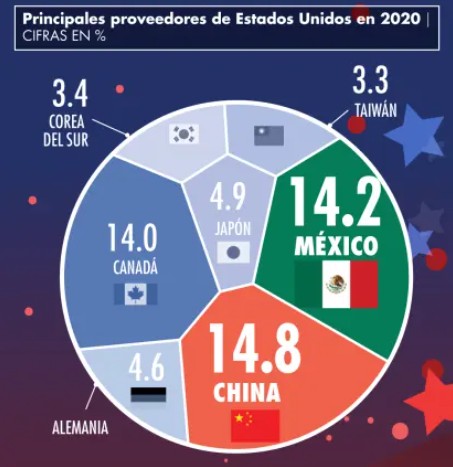
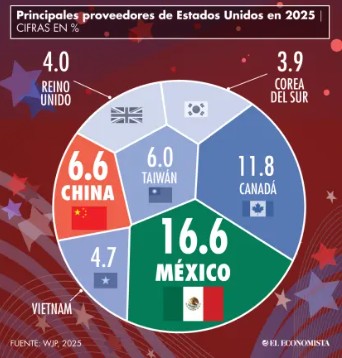 a Share of U.S. Imports
Mexico surpasses China as one of the leading suppliers to the United States under USMCA integration
Recent trade data shows:
- Mexico increasing its participation in U.S. imports
- China losing relative market share
- and North American manufacturing integration strengthening further.
This shift reflects:
- tariff diversification
- geopolitical realignment
- and supply chain regionalization.
The trend reinforces Mexico’s role as a strategic export platform for North America.
Infrastructure Is Becoming a Critical Competitive Factor
Despite strong manufacturing momentum, infrastructure remains one of Mexico’s largest long-term challenges.
Industrial organizations continue identifying bottlenecks related to:
- electricity availability
- water infrastructure
- transportation systems
- security
- and specialized labor.
These challenges are especially relevant for:
- advanced manufacturing
- automotive production
- electronics
- data centers
- and energy-intensive industries.
As nearshoring investment accelerates, infrastructure quality is becoming increasingly important for industrial site selection decisions.
Plan México and Infrastructure Investment Could Accelerate Growth
Mexico’s infrastructure initiatives are increasingly aligned with industrial development objectives.
Projects related to:
- ports
- rail infrastructure
- highways
- logistics corridors
- industrial parks
- and energy systems
could significantly improve manufacturing competitiveness in the coming years.
Financial institutions increasingly view:
- public-private coordination
- infrastructure modernization
- and logistics investment
as essential for sustaining long-term nearshoring growth.
This is particularly important because global manufacturers increasingly prioritize:
- operational reliability
- utility stability
- and long-term scalability.
Geopolitics Is Strengthening North America’s Strategic Importance
The geopolitical environment continues reinforcing North America’s industrial importance.
The United States increasingly views:
- manufacturing
- semiconductors
- logistics
- energy
- and strategic supply chains
as national security priorities.
As a result, trade policy is becoming increasingly connected to industrial strategy.
This transformation benefits Mexico because of its:
- geographic proximity
- export integration
- industrial capacity
- and manufacturing ecosystems.
North America is evolving from:
a free trade region
into:
a strategic industrial bloc.
Supply Chain Resilience Is Now a Core Investment Driver
Manufacturers are increasingly prioritizing resilience over pure efficiency.
Today, companies evaluate:
- geopolitical risks
- logistics disruptions
- transportation exposure
- energy security
- and supply chain redundancy
before making expansion decisions.
This explains why many companies continue strengthening operations in Mexico despite short-term economic uncertainty.
For many manufacturers, producing within North America has become strategically more valuable than relying exclusively on distant low-cost production hubs.
The Private Sector Continues Supporting Regional Integration
One of the strongest signals supporting continued USMCA integration is the alignment between:
- governments
- industrial developers
- manufacturers
- and financial institutions.
Business organizations and multinational manufacturers continue emphasizing the importance of:
- regional supply chains
- industrial coordination
- and long-term trade certainty.
Private sector demand remains one of the strongest drivers behind:
- industrial investment
- manufacturing expansion
- and supply chain integration across North America.
Why This Matters for Foreign Investors
For international companies, Mexico increasingly represents more than an alternative production location.
The country is becoming:
- a strategic manufacturing platform
- a North American export hub
- and a supply chain resilience solution.
However, successful expansion projects increasingly require:
- detailed site selection analysis
- infrastructure evaluations
- utility due diligence
- labor market understanding
- and regional operational expertise.
The most competitive manufacturing operations are typically built within mature industrial ecosystems rather than isolated low-cost locations.
Conclusion
USMCA, geopolitical diversification, infrastructure investment, and supply chain restructuring are reshaping manufacturing in North America.
Mexico is emerging as one of the primary beneficiaries of this transformation due to its:
- industrial integration
- manufacturing ecosystems
- geographic proximity
- and export infrastructure.
The future of manufacturing competitiveness increasingly depends on:
- regional resilience
- operational flexibility
- and supply chain security.
For foreign manufacturers and investors, the long-term direction is becoming increasingly clear:
Mexico is evolving into one of the most important manufacturing platforms in the global industrial economy.
FAQ
Why is USMCA important for manufacturing in Mexico?
USMCA provides:
- tariff stability
- regional integration
- and investment certainty for companies operating in North America.
Why are companies moving production to Mexico?
Main drivers include:
- supply chain resilience
- proximity to the U.S.
- tariff mitigation
- logistics efficiency
- and geopolitical diversification.
What industries benefit most from nearshoring in Mexico?
Key sectors include:
- automotive
- aerospace
- electronics
- medical devices
- logistics
- and industrial manufacturing.
What are Mexico’s biggest industrial challenges?
Major challenges include:
- electricity infrastructure
- water availability
- transportation bottlenecks
- security
- and skilled labor availability.
Is North America becoming more regionally integrated?
Yes. The United States, Mexico, and Canada are increasingly strengthening regional manufacturing and supply chain coordination under USMCA.