Why Mexico Is Becoming One of the World’s Most Attractive Investment Destinations

Short Answer (Executive Summary)
Mexico has become one of the most attractive investment destinations globally because it combines proximity to the U.S. market, trade certainty under USMCA, a deep and young labor pool, and scalable industrial infrastructure.Unlike previous offshoring cycles driven purely by cost, today’s investment into Mexico is driven by resilience, speed, and long-term supply chain control.
Mexico’s Strategic Position in Global Investment Flows
Mexico consistently ranks among the top 10 global recipients of foreign direct investment (FDI). This position is not accidental. It reflects a structural shift in how companies design production and logistics networks after years of disruption.
Mexico offers:
- Direct access to the world’s largest consumer market
- One of the densest cross-border logistics systems globally
- Participation in North America’s protected trade zone
Unlike distant manufacturing hubs, Mexico enables companies to produce close to demand, react faster to market changes, and reduce geopolitical exposure.
Why Mexico Is an Attractive Investment Destination
Investor perception data shows a clear hierarchy of decision drivers:
Proximity to the U.S. market is the dominant factor, followed by labor availability and cost competitiveness. Infrastructure plays a growing role, while tax incentives and legal factors are viewed as secondary — but improving.
This reflects a fundamental change:Mexico is no longer evaluated as a low-cost country, but as a strategic production platform for North America.
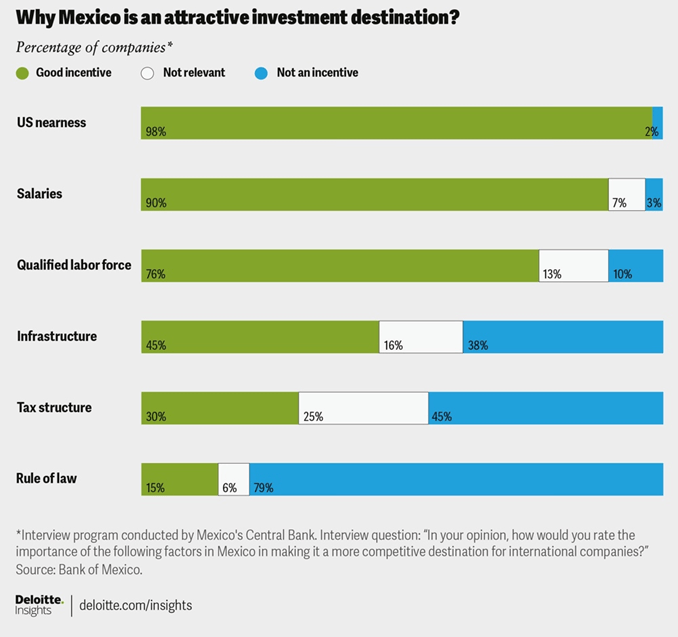
Investor perception data clearly shows that U.S. market proximity and labor availability are the dominant drivers behind Mexico’s investment appeal (see Figure 1).
Nearshoring as a Structural Economic Driver
Nearshoring to Mexico accelerated after three global shocks:
- U.S.–China trade tensions (2018)
- COVID-19 supply chain disruptions
- The Russia–Ukraine war
Each event reinforced the same lesson: long, fragile supply chains are a strategic liability.
Mexico benefited because it offers:
- Short transit times instead of multi-week ocean freight
- Time-zone alignment with U.S. operations
- Tariff protection under USMCA
As global trade rebalances, Mexico has gained U.S. import market share while China’s share has declined. This shift is structural, not cyclical.
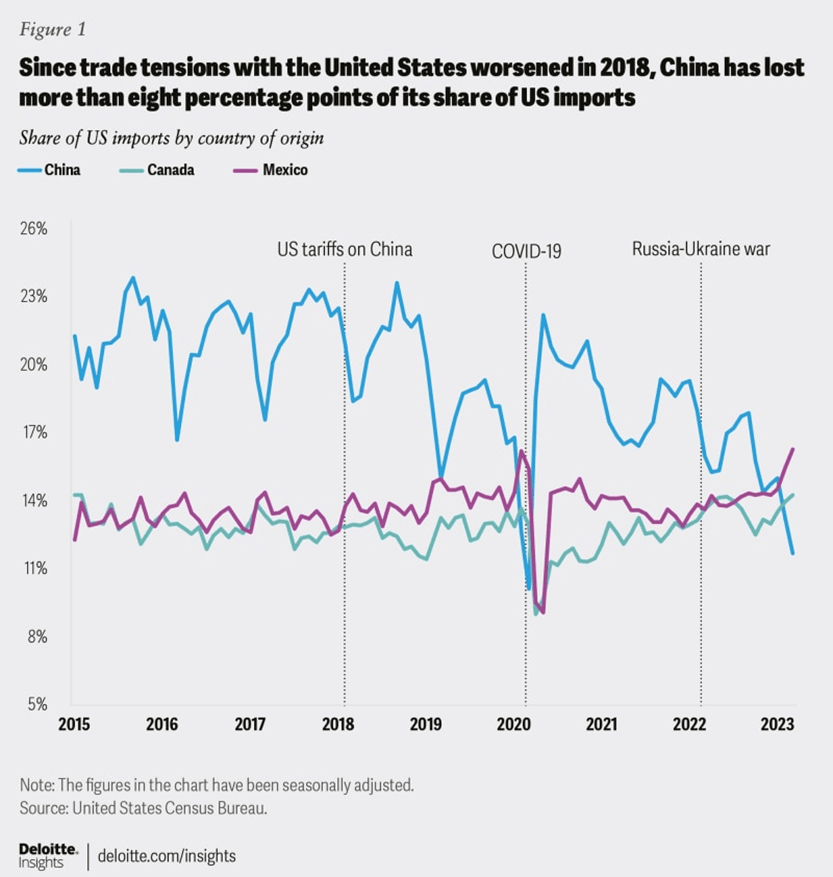
Since 2018, Mexico has gained U.S. import share as companies diversify away from China under trade and geopolitical pressure (see Figure 2).
Logistics: Mexico’s Underestimated Competitive Advantage
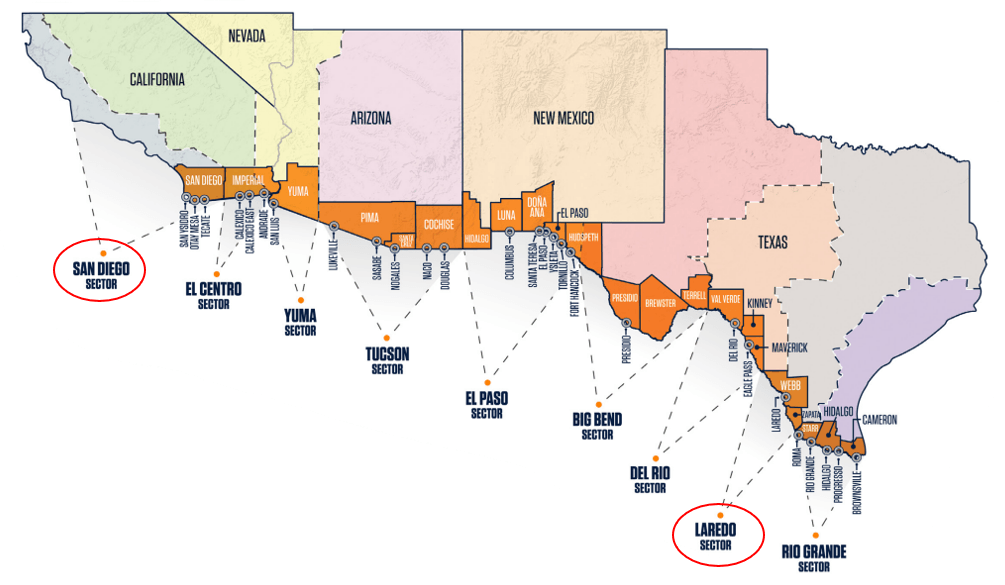
Mexico operates one of the most integrated logistics systems in the world:
- 55+ border crossings along a 2,000-mile U.S. border
- Major gateways such as Laredo, handling over 30% of U.S. imports
- 10+ container ports, extensive rail corridors, and highway networks
This infrastructure allows companies to compress lead times from weeks to days — a decisive advantage in industries with volatile demand or high customization.
Mexico’s demographic profile contrasts sharply with aging workforces in the U.S. and China (see Figure 4).
Labor and Demographics: A Long-Term Advantage
Mexico’s workforce is not only large, but structurally younger:
- Median age: ~29 years
- Large base of technically trained workers
- Strong engineering and manufacturing education pipeline
As the U.S. and Europe face demographic contraction, Mexico’s labor profile supports long-term scalability, not just initial ramp-up. This is increasingly critical for companies planning multi-decade operations rather than short investment cycles.
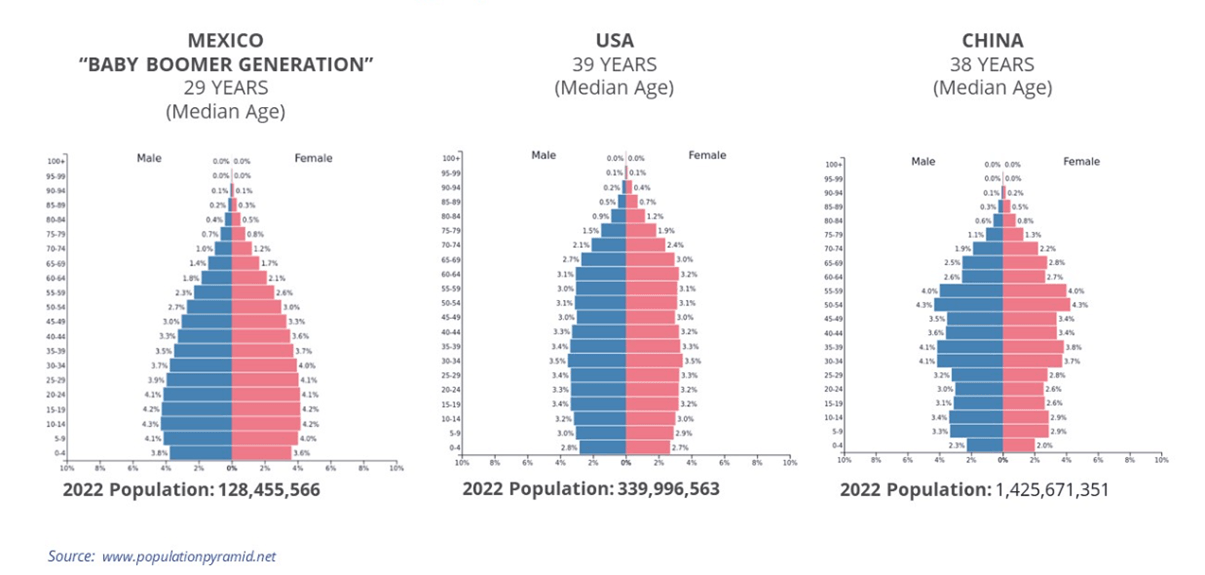
Mexico’s demographic profile contrasts sharply with aging workforces in the U.S. and China (see Figure 4).
Manufacturing Depth Beyond Assembly
Mexico’s manufacturing base has evolved far beyond basic assembly:
- Automotive, aerospace, electronics, appliances, and medical devices
- Increasing regional value content under USMCA
- Expanding supplier ecosystems in states like Nuevo León, Guanajuato, Querétaro, and Chihuahua
High-tech manufacturing and automation are growing alongside traditional industries, reinforcing Mexico’s position as a full-spectrum manufacturing economy.
Macroeconomic Stability and Investment Outlook
Mexico’s economy remains resilient:
- GDP growth supported by industrial investment
- Formal job creation at historically high levels
- Stable financial system and disciplined monetary policy
While challenges remain — particularly in energy and water infrastructure — investors continue to prioritize Mexico because no alternative market combines scale, access, and integration in the same way.
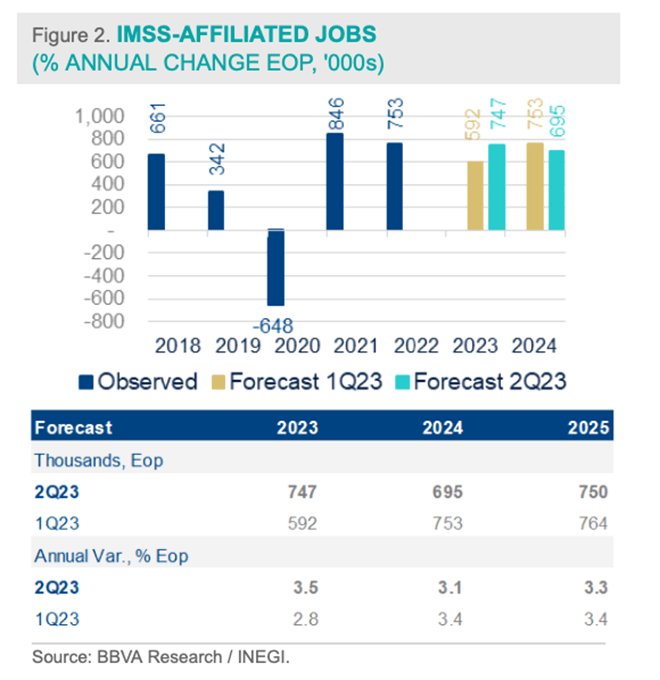
Formal job creation in Mexico has reached historically high levels, reinforcing domestic demand and industrial momentum (see Figure 5).
What This Means for Investors
Mexico’s attractiveness is no longer based on a single advantage. It is the combination that matters:
- Manufacturing in Mexico enables faster market access
- Nearshoring in Mexico reduces strategic risk
- USMCA anchors trade certainty
- Labor depth supports long-term growth
For companies redesigning supply chains, Mexico is not a workaround — it is becoming the default North American production platform.
Conclusion: Why Mexico — and Why Now
Mexico is benefiting from a rare convergence of geography, trade policy, demographics, and infrastructure. This convergence is reshaping global investment flows.
Companies that act early secure:
- Better locations
- Deeper labor pools
- Stronger integration into regional supply chains
Those who wait risk entering a more constrained, competitive environment.
Mexico is not just an alternative to Asia.It is becoming the backbone of North American manufacturing.
FAQ – Why Mexico Is an Attractive Investment Destination
Why is Mexico attractive for manufacturing investment?
Mexico combines proximity to the U.S. market, USMCA trade certainty, a young and scalable labor force, and integrated logistics infrastructure. This reduces lead times, geopolitical risk, and supply chain complexity.
Is nearshoring in Mexico a short-term trend?
No. Nearshoring in Mexico is a structural shift driven by trade policy, demographic trends, and repeated global supply chain disruptions. Companies are redesigning networks for resilience, not just cost.
How important is USMCA for investors in Mexico?
USMCA is critical. It provides tariff-free access to the U.S. market, enforces regional value content, and creates legal predictability for long-term manufacturing investment.
Which industries benefit most from investing in Mexico?
Automotive, aerospace, electronics, appliances, medical devices, and logistics-intensive industries benefit most due to supplier density, labor skills, and proximity to North American customers.
Does Mexico still offer a labor cost advantage?
Yes, but more importantly, Mexico offers labor availability and scalability. While wages are rising, they remain competitive compared to the U.S. and are supported by a young demographic profile.
What risks should investors consider when entering Mexico?
Key risks include regional infrastructure constraints (energy and water), labor competition in hot markets, and regulatory complexity. These risks are manageable with proper site selection and planning.
Bibliography
Cervantes, D., Serrano, C., Amador, J., Rodríguez, A., Aránzazu, S., & Fernández, I. (June, 2023).Mexico Economic Outlook. June 2023. Retrieved from BBVA Research: https://www.bbvaresearch.com/en/publicaciones/mexico-economic-outlook-june-2023/#:~:text=Outlook%20for%20formal%20job%20creation,grade%20will%20be%20very%20limited.
Forbes Staff. (June, 2023). OCDE eleva a 2.6% su estimación de crecimiento económico para México en 2023.Retrieved from Forbes Mexico: https://www.forbes.com.mx/ocde-eleva-estimacion-crecimiento-economico-mexico-2023/
Goodman, P. S. (February, 2023). Why "Made in China" is becoming "Made in Mexico". (S. Tavernise, Entrevistador)
McCadden, R. (June, 2023). Nearshoring in Mexico: A Game-Changer for Manufacturing Operations. Retrieved from Colliers: https://knowledge-leader.colliers.com/rafael-mccaddencolliers-com/nearshoring-in-mexico-a-game-changer-for-manufacturing-operations/
Noguez, R. (August, 2023). El peso cerrará 2023 más fuerte de lo previsto, estas son las estimaciones. Retrieved from Forbes Mexico: https://www.forbes.com.mx/el-peso-cerrara-2023-mas-fuerte-de-lo-previsto-estas-son-las-estimaciones/
Zaga, D., & Ortiz, A. (July, 2023).Nearshoring in Mexico. Retrieved from Deloitte: https://www2.deloitte.com/us/en/insights/economy/issues-by-the-numbers/advantages-of-nearshoring-mexico.html