Working Hours in Mexico Are Changing by 2030

Executive Summary
Mexico is entering a new phase of labor reform that will significantly impact industrial operations.
Key takeaways:
- Weekly working hours will be reduced from 48 to 40 hours by 2030
- Implementation starts in 2027 with gradual reductions
- Minimum wages are increasing simultaneously
- Overtime rules are becoming stricter
- Companies must adapt workforce and productivity strategies
The key insight:Mexico remains competitive—but labor efficiency and operational strategy will become critical success factors.
Introduction
For decades, Mexico’s competitive advantage in manufacturing was built on:
- Low labor costs
- Long working hours
- High workforce availability
This is now changing.
New labor reforms will reshape:
- Cost structures
- Workforce planning
- Operational efficiency
For companies entering manufacturing in Mexico, understanding these changes is essential.
Mexico’s Shift Toward a 40-Hour Workweek
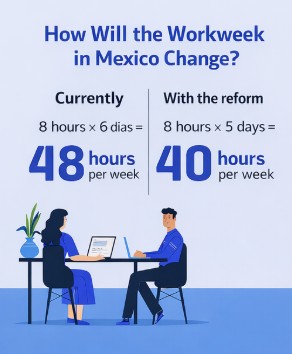
Mexico currently operates with a 48-hour workweek, significantly higher than most OECD countries.
This is now being reduced step-by-step.
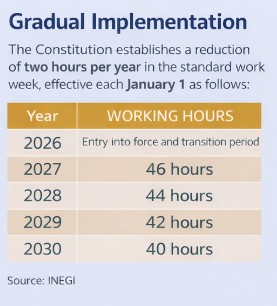
Implementation timeline:
- May 2026: Law expected to take effect
- 2027: Reduction to 46 hours
- 2028: Reduction to 44 hours
- 2029: Reduction to 42 hours
- 2030: Full transition to 40 hours
Strategic implication:
Companies have a transition window—but must act early.
Minimum Wage Increases Are Happening in Parallel
At the same time, Mexico is increasing minimum wages.
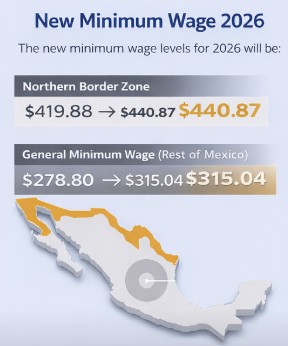
2026 wage adjustments:
- Northern border zone: +5%
- Rest of Mexico: +13%
Objective of the policy:
- Increase purchasing power
- Reduce regional inequality
- Strengthen domestic demand
What This Means for Labor Costs
The combination of:
- Fewer working hours
- Higher wages
creates a structural shift.
Key impact:
- Higher cost per hour worked
- Pressure on productivity
- Need for workforce optimization
However:
Mexico still remains cost-competitive globally, especially compared to the U.S. and Europe.
Overtime and Compliance Requirements Are Tightening
New regulations introduce stricter compliance rules.
Key requirements:
- Electronic time tracking becomes mandatory
- Overtime limited to 12 hours per week
- Overtime pay:
- Double pay within limits
- Triple pay if limits are exceeded
Implication:
- Increased compliance complexity
- Higher cost of inefficient operations
Why Mexico Is Making These Changes
The reforms are not random—they follow a clear strategy.
Policy goals:
- Improve worker conditions
- Increase domestic consumption
- Align with international labor standards
- Reduce regional inequality
For investors, this signals:
Mexico is transitioning from a low-cost economy to a value-driven economy.
Impact on Manufacturing in Mexico
The export-oriented manufacturing sector will be most affected.
Key challenges:
- Adjusting shift models
- Maintaining production output
- Managing rising labor costs
Key opportunities:
- Process optimization
- Automation investments
- Workforce upskilling
Companies that adapt early will benefit.
Productivity Becomes the New Competitive Advantage
With fewer working hours, productivity per hour becomes critical.
Companies must focus on:
- Lean manufacturing
- Automation
- Workforce training
- Digitalization
The model is shifting from:
Low-cost + long hours → Higher productivity + efficiency
Mexico vs Global Standards
Even after reform:
- Mexico remains competitive vs OECD countries
- Labor costs are still significantly lower than the U.S.
- Proximity advantage remains unchanged
Compared to Asia:
- Mexico offers shorter lead times
- Better supply chain control
- Lower geopolitical risk
What This Means for Companies Expanding to Mexico
1. Workforce planning must change
Companies need to:
- Redesign shift structures
- Optimize staffing levels
2. Automation becomes essential
Reducing hours increases the need for:
- Process automation
- Efficiency improvements
3. Site selection becomes more critical
Labor cost + availability + productivity vary by region.
This makes site selection Mexico even more strategic.
Strategic Insight: Mexico Is Moving Up the Value Chain
The reform signals a structural shift:
Mexico is no longer competing purely on cost.
It is competing on:
- Productivity
- Quality
- Supply chain integration
This aligns perfectly with the nearshoring Mexico trend.
Conclusion
Mexico’s labor reform will reshape the industrial landscape.
Key takeaways:
- Working hours are decreasing
- Labor costs are increasing
- Compliance requirements are rising
However:
Mexico remains one of the most attractive manufacturing locations globally.
Success will depend on:
- Efficiency
- Planning
- Strategic execution
FAQ
What are current working hours in Mexico?Currently 48 hours per week, gradually reducing to 40 by 2030.
When does the 40-hour workweek start?The transition begins in 2027 and ends in 2030.
Are labor costs increasing in Mexico?Yes, due to wage increases and reduced working hours.
How does this affect manufacturing companies?It increases cost pressure but also drives efficiency improvements.
Is Mexico still competitive after these reforms?Yes, especially due to proximity to the U.S. and strong supply chains.
Why Mexecution
Labor reforms in Mexico directly impact:
- Cost structures
- Workforce availability
- Operational efficiency
Understanding how these changes affect your expansion strategy is critical.
Mexecution supports companies with:
- Data-driven site selection Mexico aligned with labor market dynamics
- Identification of regions with optimal workforce conditions
- Strategic advisory on industrial setup and expansion
- Transparent and independent guidance without commission bias
Adapting early to labor changes is not a risk—it is a competitive advantage.