How Industrial Parks in Mexico Are Classified — The AMPIP Framework Explained

How Industrial Parks in Mexico Are Classified — The AMPIP Framework Explained
Executive Summary
Most foreign manufacturers evaluating industrial space in Mexico focus on building class — Class A, B, or C — as their primary evaluation framework. This is a useful starting point, but it addresses only the building itself, not the park that surrounds it. Mexico's industrial parks are classified by a separate framework maintained by AMPIP, the country's industrial park association representing 95% of private industrial real estate developers. That framework categorizes parks by three dimensions: vocación (operational purpose), tamaño (size), and perímetro (perimeter type). Understanding these dimensions matters because they determine what types of operations a park is designed to support, what infrastructure and services are included, and whether a specific park is the right fit for a manufacturer's operational profile — before a single building specification is evaluated.
Why Building Class Alone Is Not Enough
Class A, B, and C classifications describe the quality and specifications of an individual industrial building: clear height, floor load capacity, dock doors, ESFR sprinkler systems, and construction standards. A Class A building in a poorly managed park with unreliable shared infrastructure provides meaningfully less operational certainty than the same building in a park with dedicated utility systems, perimeter security, and professional administration.
The AMPIP classification framework addresses the park level, not the building level. It answers a different set of questions: Is this park designed for manufacturing, logistics, or both? Is it large enough to support an ecosystem of suppliers and service providers, or is it a smaller single-use facility? Does it operate as a controlled, closed industrial zone or an open-access development? These questions are operationally consequential for manufacturers making long-term location decisions, and they are not answered by building class alone.
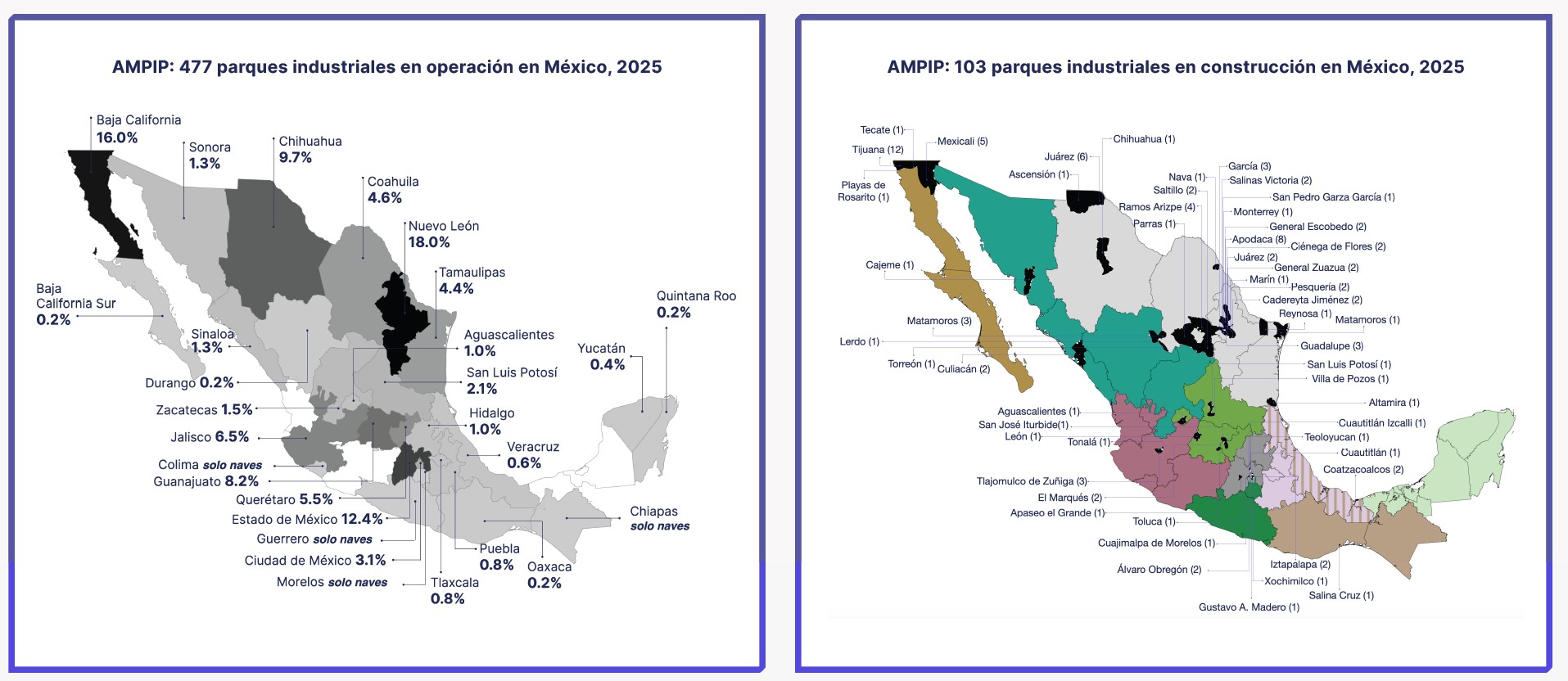
Mexico's 477 operational industrial parks vary considerably across all three AMPIP dimensions. A foreign manufacturer evaluating industrial space in Monterrey, Querétaro, or Tijuana will encounter parks that differ not only in location and rent but in fundamental operational design. The AMPIP framework provides the vocabulary for evaluating those differences systematically.
Dimension 1: Vocación — What the Park Is Designed For
Vocación is the most operationally significant classification dimension. It defines the primary purpose of the park and the type of companies it is designed to attract and support.
AMPIP recognizes four vocational categories:
| Vocación | Definition | Share of operational parks |
|---|---|---|
| Logística | Primarily logistics and distribution operations | 62% |
| Manufactura | Primarily manufacturing and production operations | 17% |
| Uso Mixto | Combined manufacturing and logistics | 7% |
| Dedicado | Dedicated to a specific OEM or anchor tenant's supplier network | 1% |
The dominance of logistics vocación at 62% of operational parks reflects the growth of e-commerce, distribution, and third-party logistics operations in Mexico alongside manufacturing. For a foreign manufacturer, this distribution has a direct implication: the majority of industrial parks in Mexico are designed and optimized primarily for logistics operations, not manufacturing.
A logistics-vocación park and a manufacturing-vocación park are not interchangeable. Manufacturing parks are designed with higher power capacity, heavier floor load specifications, more robust utility infrastructure, and in many cases proximity to supplier ecosystems specific to their primary industry. Logistics parks prioritize dock-door ratios, trailer staging areas, proximity to highway interchanges, and cross-docking capability. A manufacturer placing a production facility in a logistics-dominated park may find that energy capacity, water supply, and operational services are calibrated to lighter-use requirements than production operations demand.
The uso mixto category — parks that accommodate both manufacturing and logistics — offers the most flexibility and currently represents 7% of operational parks. Most of the 20 parks delivered under Plan México in early 2026 carry a uso mixto designation, reflecting the government program's intention to create flexible industrial infrastructure rather than single-sector zones.
The dedicado category — dedicated parks serving a specific OEM's supplier network — represents the most specialized and least accessible vocación for incoming manufacturers without an existing relationship with the anchor tenant. Dedicated parks function as extended supply chain ecosystems for a single large manufacturer, typically an automotive OEM, where all tenants are vetted suppliers. Tier 1 and Tier 2 automotive suppliers entering Mexico specifically to serve a named OEM may find that a dedicated park adjacent to that OEM's assembly facility offers supply chain advantages that outweigh the flexibility limitations of the model.
Dimension 2: Tamaño — The Size Classification
AMPIP classifies industrial parks by physical area across three size tiers. Size determines the range of industrial uses a park can accommodate, the diversity of its tenant base, and the scale of shared infrastructure investment that the developer can justify.
| Tamaño | Area Range | Share of operational parks |
|---|---|---|
| Tamaño I (Small) | 2 to 7 hectares | 13% |
| Tamaño II (Medium) | 7 to 75 hectares | 56% |
| Tamaño III (Large) | More than 75 hectares | 31% |
The majority of Mexico's operational industrial parks — 56% — fall in the medium size range of 7 to 75 hectares. This range is broad enough to support a diverse mix of manufacturing and logistics tenants while remaining manageable from an infrastructure and administration standpoint.
Size matters for manufacturers in ways that are not immediately obvious from a building-level evaluation.
Tamaño I parks (2–7 hectares) typically accommodate a small number of tenants — sometimes as few as two or three buildings — and share infrastructure costs across a limited base. This constrains the level of investment the park developer can make in dedicated utility infrastructure, security systems, and service amenities. For manufacturers requiring high energy capacity, robust water systems, or 24-hour security with controlled access, small parks may lack the economies of scale to provide these services at the standard that advanced manufacturing operations require.
Tamaño II parks (7–75 hectares) represent Mexico's workhorse industrial real estate category. A park at the upper end of this range — 60 to 75 hectares — can host 10 to 20 manufacturing and logistics tenants of varying sizes, support dedicated substation infrastructure, and maintain professional park administration services. For most foreign manufacturers entering Mexico for the first time, medium-size parks in established corridors offer the best combination of infrastructure maturity, tenant ecosystem density, and operational flexibility.
Tamaño III parks (more than 75 hectares) represent Mexico's large-format industrial developments — complexes where the park itself functions as a manufacturing ecosystem. Guanajuato Puerto Interior at 1,200 hectares and Interpuerto Monterrey at 1,200 hectares represent the extreme upper end of this category. Parks of this scale can support dedicated customs infrastructure, intermodal logistics terminals, and a supplier density that creates meaningful supply chain advantages for manufacturers within the complex. For companies with large footprint requirements or those seeking to co-locate with existing supplier networks, Tamaño III parks warrant priority evaluation.
Dimension 3: Perímetro — Open vs. Closed
The perímetro dimension addresses how the park manages physical access — whether it operates as a closed, controlled industrial zone or an open development integrated with its surrounding area.
| Perímetro | Description | Share of operational parks |
|---|---|---|
| Cerrado (Closed) | Controlled perimeter with defined access points, security infrastructure, and restricted entry | 76% |
| Abierto (Open) | No defined perimeter or controlled access; buildings may be located in an industrial zone without shared security infrastructure | 24% |
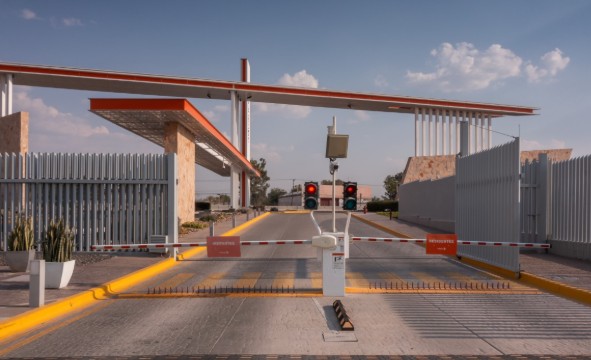
The 76% majority of Mexico's operational industrial parks operate as closed, controlled perimeters. This is not simply a security preference — it reflects the operational requirements of the manufacturing and logistics companies that represent the primary tenant base.
A closed-perimeter park provides a fundamentally different operating environment from an open development. Controlled access means that vehicle entry and exit is monitored, visitor protocols are enforced, and cargo movement is tracked through defined checkpoints. This matters for manufacturers in several operational dimensions: intellectual property protection is more manageable when physical access to production areas is controlled; cargo security is meaningfully higher when inbound and outbound logistics move through documented checkpoints; and compliance with customer and certification requirements — particularly relevant for automotive, aerospace, and medical device manufacturers — is more straightforward in a controlled environment.
For foreign manufacturers entering Mexico, a closed-perimeter park is generally the appropriate baseline requirement for any advanced manufacturing operation. The 24% of parks operating without controlled perimeters typically include older industrial zones, standalone industrial property developments, and secondary-market parks where the infrastructure investment required for perimeter control has not been made. These parks may offer lower rental rates, but the operational trade-offs are real and should be evaluated explicitly rather than accepted as a cost-saving measure by default.
How the Three Dimensions Combine in Practice
The three AMPIP dimensions — vocación, tamaño, and perímetro — operate simultaneously, and the combination determines whether a specific park is actually appropriate for a given manufacturing operation.
A Tamaño III, manufactura-vocación, cerrado park — a large, manufacturing-focused, closed-perimeter development — represents the highest-capability industrial park category in Mexico. These parks typically host the most demanding manufacturing operations: automotive Tier 1 suppliers, aerospace component manufacturers, and advanced electronics producers. Infrastructure investment is highest, tenant ecosystem density is greatest, and operational certainty is strongest. Industrial Parks like those in Saltillo's automotive corridor or Querétaro's aerospace cluster approximate this profile.
A Tamaño I, logística-vocación, abierto park — a small, logistics-focused, open development — represents the lowest-complexity category. These parks serve distribution operations, light warehousing, and domestic logistics. They are not appropriate environments for export manufacturing operations requiring dedicated energy infrastructure, controlled access, or supplier ecosystem proximity.
Most foreign manufacturers evaluating Mexico will find their requirements best served by parks in the medium to upper range of the tamaño classification, with manufactura or uso mixto vocación, and cerrado perímetro. This combination exists across Mexico's primary manufacturing corridors — Nuevo León, Coahuila, Chihuahua, Querétaro, Guanajuato, and Jalisco — in sufficient quantity to provide meaningful choice during site selection.
The AMPIP Classification and Plan México's New Parks
The 20 industrial parks delivered under Plan México as of February 2026 provide a useful current example of how the AMPIP classification applies to new supply entering the market. Of the 20 parks, the predominant vocación designation is uso mixto — reflecting the program's intentional design for flexibility across both manufacturing and logistics tenants. The size distribution across the 20 parks spans Tamaño II and Tamaño III categories, as the Plan México framework specifically targets parks capable of hosting multiple companies across diverse industrial sectors. All 20 parks operate as closed perimeters, consistent with the standard for professionally managed private industrial parks under the AMPIP framework.
For companies evaluating whether a specific Plan México park is appropriate for their operations, the vocación and tamaño dimensions provide the fastest initial filter. A uso mixto park at the lower end of Tamaño II may be adequate for a logistics operation or light assembly but insufficient for a high-energy manufacturing process requiring dedicated infrastructure. A Tamaño III park with manufactura vocación in Nuevo León or Querétaro offers a fundamentally different capability profile even if the headline rent per square meter is similar.
For a current view of available industrial space across Mexico's primary markets — including which submarkets are operating near full occupancy and where new supply is entering — see our Monterrey industrial market Q1 2026 analysis. For the full infrastructure evaluation framework that applies across park types and locations, see our 2026 industrial site selection checklist.
Conclusion
Mexico's industrial park market is not a homogeneous inventory of interchangeable locations. The AMPIP classification framework — vocación, tamaño, and perímetro — provides a structured way to distinguish parks that are designed for manufacturing from those optimized for logistics, parks with the scale to support advanced infrastructure from those with limited shared services, and parks with controlled operating environments from open developments with minimal access management.
For foreign manufacturers, applying this framework as a first-pass filter before evaluating individual buildings reduces the risk of selecting a location that is physically available but operationally mismatched with production requirements. The right building in the wrong type of park carries operational costs that do not appear in the lease agreement.
Mexico has 477 operational industrial parks and 103 under construction. The classification framework is what makes that number navigable.
FAQ
What is AMPIP and how does it classify industrial parks in Mexico?
AMPIP is the Asociación Mexicana de Parques Industriales Privados, representing 95% of Mexico's private industrial real estate developers. It classifies industrial parks across three dimensions: vocación (operational purpose — logistics, manufacturing, mixed-use, or dedicated), tamaño (size — small, medium, or large by hectares), and perímetro (perimeter type — closed with controlled access or open). These dimensions describe the park itself, separate from the Class A/B/C classification that describes individual buildings within parks.
What is the difference between a manufacturing and logistics industrial park in Mexico?
A manufacturing-vocación park is designed and infrastructure-equipped for production operations: higher energy capacity, heavier utility systems, and proximity to supplier ecosystems specific to manufacturing industries. A logistics-vocación park prioritizes distribution efficiency: dock-door ratios, trailer staging, and highway access. The two park types serve different operational purposes and should not be treated as interchangeable when evaluating industrial space for a production facility.
What percentage of Mexico's industrial parks are closed-perimeter developments?
According to AMPIP's June 2025 classification data, 76% of Mexico's 477 operational industrial parks operate as closed, controlled-perimeter developments with defined access points and security infrastructure. The remaining 24% are open developments. For advanced manufacturing operations — particularly in automotive, aerospace, and medical devices — a closed-perimeter park is the appropriate baseline requirement for cargo security, intellectual property protection, and compliance with customer certification standards.
What size industrial park is best for a foreign manufacturer entering Mexico?
Most foreign manufacturers entering Mexico for the first time find their requirements best served by Tamaño II parks (7–75 hectares) at the upper end of the size range, or Tamaño III parks (more than 75 hectares). These parks can support dedicated substation infrastructure, professional park administration, and sufficient tenant density to create a functioning supplier ecosystem. Tamaño I parks (2–7 hectares) typically lack the scale to support advanced manufacturing infrastructure requirements at competitive service levels.
What does uso mixto vocación mean for an industrial park in Mexico?
Uso mixto (mixed-use) means the park accommodates both manufacturing and logistics operations simultaneously. It is the most flexible vocational designation and represents 7% of Mexico's operational parks. Most of the 20 new parks delivered under Plan México in early 2026 carry uso mixto designations, designed to attract a diverse tenant mix rather than a single-sector focus. For manufacturers who also require on-site distribution capability, uso mixto parks offer the advantage of integrating production and logistics operations within a single controlled environment.
How does the AMPIP park classification relate to Plan México's new industrial park program?
The 20 parks delivered under Plan México as of February 2026 are classified under the AMPIP framework like any other private industrial park. Their predominant vocación is uso mixto, their size distribution spans Tamaño II and Tamaño III, and all operate as closed-perimeter developments. The Plan México designation confirms government program alignment but does not replace the AMPIP classification as the operational evaluation framework for manufacturers selecting between park options.