Plan México's 100 Industrial Parks: What the Build-Out Means for Foreign Manufacturers Entering Mexico

Plan México's 100 Industrial Parks: What the Build-Out Means for Foreign Manufacturers Entering Mexico
Executive Summary
Mexico's federal government set an ambitious industrial infrastructure target under Plan México: 100 new industrial parks developed between 2024 and 2030. As of February 2026, 20 parks have already entered operation — approximately 500 days into the program — representing more than USD 711 million in private investment, 3.5 million square meters of new industrial space, and capacity for 245 companies generating an estimated 62,000 direct jobs. The program is being executed with operational leadership from AMPIP, which simultaneously runs its own parallel program targeting 128 new industrial parks by 2030 with an estimated investment of USD 6.2–8.6 billion. For foreign manufacturers evaluating industrial expansion in Mexico, this build-out has a direct operational implication: new, modern industrial space is entering the market across corridors that previously had limited availability. But the program's pace — and the infrastructure constraints that accompany it — also determine where that space will be ready, when, and whether it can actually support advanced manufacturing operations from day one.
What Plan México's Industrial Park Program Actually Is
Plan México is a national economic strategy announced by the Sheinbaum administration to strengthen Mexico's productive infrastructure, attract foreign and domestic investment, and position the country as a reliable manufacturing base for North American supply chains. Within the plan, the 100 industrial parks target is the most concrete and measurable commitment: 100 new operational industrial parks across Mexican territory by 2030, developed by private industrial real estate developers under a framework coordinated by AMPIP and the federal government's Regional Economic Development and Relocation Advisory Council (CADERR).
The program is not a government construction initiative. The Mexican federal government is not building these parks itself. The 100-park target is achieved through private developers — 15 of whom have already contributed to the first 20 deliveries — operating within a framework that AMPIP coordinates with federal, state, and municipal authorities. What the government provides is the institutional framework, investment promotion, and regulatory coordination. What developers provide is capital, construction, and operational management.
This distinction matters for foreign manufacturers. The parks being delivered under Plan México are private-sector industrial developments meeting commercial standards, not government-administered industrial zones. They compete for tenants on the basis of location, infrastructure quality, and service levels — the same criteria that govern any industrial real estate decision.
The Progress So Far: 20 Parks in 500 Days
The milestone announced at AMPIP's first 2026 General Assembly — 20 parks operational within approximately 500 days of the program's launch — represents meaningful early momentum.
| Program Indicator | Figure |
|---|---|
| Parks operational (Feb 2026) | 20 |
| Private investment committed | USD 711 million+ |
| Industrial space capacity | 3.5 million m² |
| Companies to be hosted | 245 |
| Estimated direct jobs | 62,000 |
| States with operational parks | 10 |
| Developers contributing | 15 |
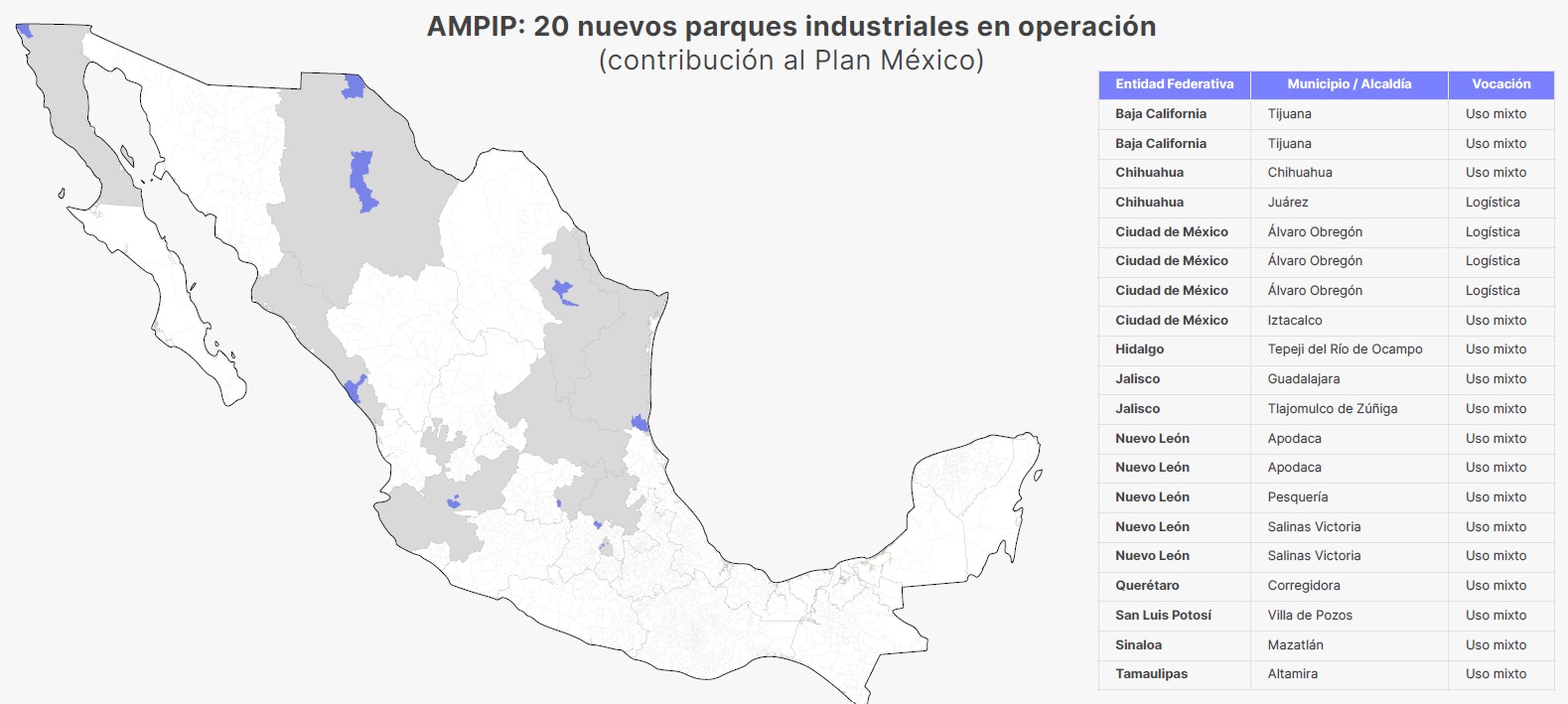
The 20 parks span 10 states: Nuevo León, Baja California, Chihuahua, Ciudad de México, Hidalgo, Jalisco, Querétaro, San Luis Potosí, Sinaloa, and Tamaulipas. Nuevo León leads with five parks — located in Apodaca, Pesquería, and Salinas Victoria — reinforcing its position as Mexico's largest industrial market while also adding capacity in submarkets outside the Monterrey core. The parks' vocational profile is predominantly uso mixto (mixed-use), meaning they accommodate both manufacturing and logistics operations rather than a single sector — an intentional design choice reflecting the diversity of nearshoring demand.
For context, these 20 parks join a national base of 477 industrial parks already in operation, which together host more than 4,000 companies and support over 3.7 million jobs across 28 states, according to AMPIP's June 2025 classification data.
The Full Pipeline: AMPIP's 2024–2030 Development Program
Beyond the Plan México goal of 100 parks, AMPIP's own sectoral program targets 128 new industrial parks by 2030 — a figure that encompasses Plan México deliveries plus additional private development outside the government program's specific framework.
The annual delivery schedule from AMPIP's program shows how the pipeline is distributed over time:
| Year | New Parks | New Area |
|---|---|---|
| 2024 | 72 | 15.44 million m² |
| 2025 | 17 | 1.76 million m² |
| 2026 | 12 | 1.32 million m² |
| 2027 | 14 | 1.45 million m² |
| 2028 | 9 | 0.60 million m² |
| 2029 | 4 | 0.37 million m² |
The 2024 figure of 72 parks reflects new park registrations and permitting initiations — the majority are in Stage 0 (land designated, permitting begun) or Stage 1 (permits obtained, development underway). Of the 103 parks under construction as of mid-2025, 39% are in Stage 0, 19% in Stage 1 (permits secured), 15% in Stage 2 (infrastructure underway), and 27% in Stage 3 (ready to operate). This stage distribution explains the gap between parks announced and parks delivering tenant-ready space: a significant portion of the 2024–2026 registration cohort will produce physically available industrial space between 2026 and 2028.
Investment in industrial parks is projected to rise 36.6% in 2026 to USD 5.831 billion — up from USD 4.266 billion in 2025 and USD 3.875 billion in 2024. Of the 2026 projected total, 66.1% is expected to flow into new park developments and new industrial buildings within parks, while 19.3% will go toward upgrading existing parks.
For foreign manufacturers tracking when new space will actually be available for lease negotiations, the Stage 3 figure — 27% of the construction pipeline — represents approximately 28 parks nationally that are tenant-ready or approaching that status as of mid-2025.
The Corridors Being Built and What They Mean for Site Selection
The 128 new parks in AMPIP's program are not distributed evenly across Mexico. They concentrate in corridors that reflect both nearshoring demand patterns and government strategic priorities under Plan México.
The primary corridors receiving new industrial park development include:
The Norte corridor — Tijuana, Ciudad Juárez, Chihuahua, Matamoros, Reynosa — continues to receive new park development driven by cross-border manufacturing demand, proximity to U.S. customers, and automotive supply chain density. Tijuana alone has 12 parks in the new development pipeline as of 2024 AMPIP data, and Ciudad Juárez has 9.
The Bajío corridor — Guanajuato, Querétaro, San Luis Potosí, Aguascalientes — is receiving significant new supply across multiple municipalities including El Marqués, Corregidora, León, and San José Iturbide. This corridor combines automotive cluster maturity with growing electronics and medical device presence, making it the most diversified industrial corridor in the country.
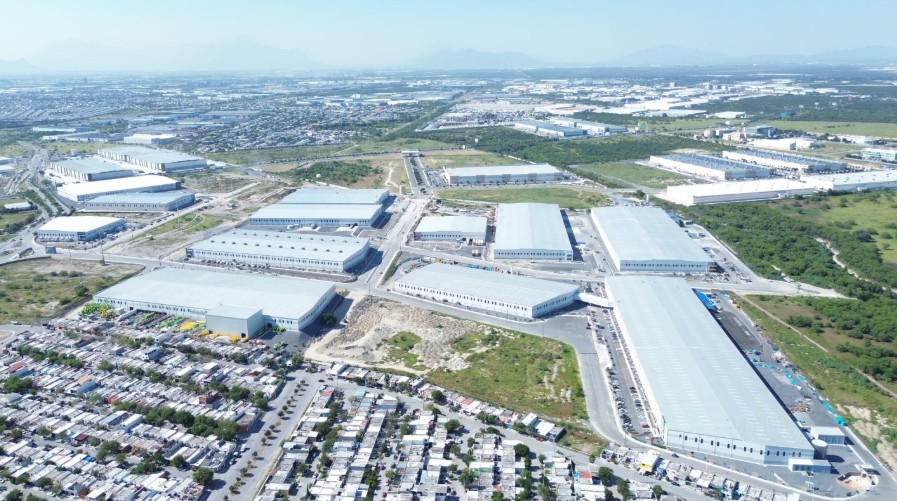
The Nuevo León / Noreste corridor — Apodaca, Pesquería, Salinas Victoria, Ciénega de Flores, García — is adding new parks to its established industrial base. With five of the first 20 Plan México parks located here and 38 additional parks under construction in the state, Nuevo León is reinforcing its position as Mexico's largest single industrial market, currently hosting approximately 260 operational parks and projected to exceed 300 with parks under development.
The Pacific and Istmo de Tehuantepec corridors — Mazatlán, Salina Cruz, Coatzacoalcos — represent Plan México's geographic expansion ambition beyond the established northern and Bajío markets. These corridors offer lower land costs and Pacific access for Asia-facing trade flows, but carry higher infrastructure uncertainty given the earlier stage of their industrial ecosystems.
The Energy Constraint That Determines Whether New Parks Actually Deliver
The most operationally significant challenge in Mexico's industrial park expansion program is not the construction pace — it is energy infrastructure. AMPIP has been explicit about the scale of the problem.
Mexico's 477 operational industrial parks already require approximately 13,200 megawatts of installed capacity. The 103 parks under construction will require an additional 2,434 megawatts when fully operational. Energy demand from new industrial developments is projected to grow 25% by 2025 and reach 3,000 megawatts of additional capacity requirement by 2029 — driven not only by manufacturing volume growth but by the arrival of energy-intensive sectors including data centers, EV battery production, and advanced electronics manufacturing, whose individual project demands can reach up to 250 megawatts.
AMPIP's proposed solution involves two parallel tracks. The first is a public-private co-investment framework to strengthen transmission and distribution infrastructure in high-demand corridors — specifically the 3,000 megawatts of additional capacity the program requires. The second is a regulatory adjustment to increase the distributed generation capacity limit from 0.5 to 1 megawatt per installation, enabling 50% of industrial rooftop space to be used for solar generation. AMPIP estimates that applying this initiative to projected new industrial rooftops alone could generate approximately 860 megawatts of distributed capacity, with an additional 8,000 megawatts potentially available from the rooftops of the 80 million square meters of parks already in operation. The total investment required for this solar rooftop initiative is estimated at USD 6 billion.
For foreign manufacturers, the energy dimension of Plan México's park program has a direct site selection implication. A new park entering Stage 3 — tenant-ready — does not automatically mean energy infrastructure is mature enough to support the full range of manufacturing operations. Parks with dedicated substations, documented capacity headroom, and backup generation infrastructure should be distinguished from parks where grid connection relies on shared or overloaded transmission infrastructure. The Plan México framework does not uniformly guarantee energy readiness across all 100 parks.
The Regulatory Dimension: 36 Permits Per Park
The construction speed of new industrial parks is constrained not only by capital and energy but by the regulatory approval process that governs every new development. AMPIP's own survey of its membership identified approximately 36 permits required to develop a single industrial park: 13 with federal authorities, 10 with state authorities, and 13 with municipal authorities.
Every one of the developers delivering parks under Plan México must navigate this process. The 100% of AMPIP developers report the environmental impact-related permits — at least seven separate procedures across federal, state, and municipal levels — as "very complicated" or "complicated," with 60% reporting lack of coordination between the responsible authorities as a primary obstacle.
This regulatory reality explains why the Stage 0 to Stage 3 transition — from land designation to tenant-ready operation — takes considerably longer than the construction period itself. For manufacturers evaluating parks that are currently in development stages, the permitting timeline is the primary uncertainty in predicting when space will actually be available for occupancy.
AMPIP's proposed solution is a cross-government digital platform functioning as a single window (ventanilla única) across all three government levels, standardizing requirements, automating documentation transfer between agencies, and providing clear processing timelines. Until such a platform is operational, project timelines for parks in Stage 0 and Stage 1 carry meaningful schedule uncertainty that should be reflected in any lease negotiation involving pre-leased space in parks under development.
What This Means for a Foreign Manufacturer Evaluating Industrial Space in Mexico
Plan México's 100-park program is expanding Mexico's industrial real estate supply across corridors that previously had limited Class A availability. For companies currently in site selection, the program creates both opportunity and a specific evaluation requirement.
The opportunity is tangible. New parks entering Stage 3 in established corridors like Nuevo León, Querétaro, and the Bajío provide modern facilities with infrastructure standards designed for current manufacturing requirements — often with more flexible lease terms than parks in the most constrained existing markets, where Apodaca operates at 96–97% occupancy and El Marqués at 94–96%.
The evaluation requirement is equally tangible. Not every park under development under Plan México represents equivalent infrastructure quality. The distinctions that matter for operational decisions are energy infrastructure status (dedicated substation vs. shared grid connection), water supply reliability, permitting stage (Stage 3 vs. Stage 0–2), distance to border crossings and logistics corridors, and the developer's track record with comparable manufacturing tenants.
The fact that a park is associated with Plan México provides institutional context but not a standardized infrastructure guarantee. The evaluation process that applies to any industrial park in Mexico — energy, water, logistics, regulatory clearance — applies equally to new parks entering under this program.
For an analysis of infrastructure variables across Mexico's primary industrial markets, see our 2026 industrial site selection checklist. For current market conditions and lease dynamics in Monterrey — the market where five of the first 20 Plan México parks are located — see our Monterrey industrial market Q1 2026 analysis.
Conclusion
Plan México's 100 industrial parks program represents the most structured government-private sector coordination effort in Mexico's industrial real estate history. Twenty parks operational in 500 days, USD 711 million invested, and a construction pipeline covering 103 additional parks across 52 municipalities confirms that the program is executing — not simply announcing.
For foreign manufacturers, the program's practical significance is the addition of modern industrial space in corridors where availability had constrained entry options during the 2022–2024 peak absorption cycle. The pipeline is real, the investment is committed, and the geographic distribution covers Mexico's primary manufacturing corridors.
What the program does not resolve automatically is the energy infrastructure gap that AMPIP itself identifies as the primary constraint on industrial competitiveness — 3,000 megawatts of additional capacity required, USD 6 billion in solar infrastructure investment needed, and a regulatory approval process of 36 permits per park that continues to determine construction timelines. These are the variables that distinguish parks ready for advanced manufacturing operations from parks that are physically complete but operationally limited.
The 100-park target is on track. Whether individual parks deliver the operational conditions that specific manufacturing projects require is the question that site selection due diligence must answer.
FAQ
How many industrial parks does Mexico have in 2026?
As of mid-2025, Mexico has 477 industrial parks in operation across 28 states, hosting more than 4,000 companies and supporting over 3.7 million jobs, according to AMPIP. An additional 103 parks are under construction representing 21.5 million square meters of future industrial space. Plan México targets 100 new parks by 2030, of which 20 were operational as of February 2026.
What is Plan México's 100 industrial parks program?
Plan México is Mexico's federal economic strategy under President Claudia Sheinbaum. Its industrial parks component targets the development of 100 new industrial parks across Mexican territory by 2030, coordinated by AMPIP with private sector developers providing capital and construction. As of February 2026, 20 parks have entered operation representing USD 711 million in investment and 3.5 million square meters of industrial capacity.
Which states have the most new industrial parks under Plan México?
Nuevo León leads with five of the first 20 Plan México parks, located in Apodaca, Pesquería, and Salinas Victoria. The program also includes parks in Baja California (Tijuana), Chihuahua (Juárez and Chihuahua city), Jalisco (Guadalajara and Tlajomulco), Querétaro (Corregidora), San Luis Potosí (Villa de Pozos), Sinaloa (Mazatlán), and Tamaulipas (Altamira).
How much investment is going into Mexico's industrial park sector in 2026?
AMPIP projects industrial park investment of USD 5.831 billion in 2026 — a 36.6% increase over 2025's USD 4.266 billion. Of this, 66.1% is directed toward new park developments and new industrial buildings within parks, while 19.3% goes toward upgrades of existing parks.
Why is energy infrastructure a constraint on Mexico's industrial park expansion?
Mexico's 477 operational industrial parks already require approximately 13,200 megawatts of installed capacity. The 103 parks under construction will add 2,434 megawatts of additional demand. New energy-intensive sectors — data centers, EV battery manufacturing, advanced electronics — can require up to 250 megawatts per project. AMPIP estimates 3,000 additional megawatts are needed by 2029 and has proposed a USD 6 billion solar rooftop initiative to close part of the gap using 50% of industrial building rooftop capacity.
Are Plan México industrial parks suitable for advanced manufacturing operations?
Not uniformly. Parks entering operation under Plan México vary in infrastructure maturity. Energy infrastructure status — dedicated substation versus shared grid connection — water supply reliability, permitting completion stage, and logistics corridor proximity are the key variables that determine whether a specific park can support advanced manufacturing from day one. Association with Plan México provides institutional context but not a standardized infrastructure guarantee across all 100 parks.